
by Denise Olivares-Molina | May 18, 2026 | Advice for Buyers, Advice for Buyers and Sellers, Advice for Sellers, Affordability, Buyers, Buying A Home, Buying Tips, First-Time Buyers, For Buyers, FSBOs, Home value, Homeowner Information, Housing Market, Housing Market Shifts, Housing Market Updates, Investment, Investment Strategy, Pricing, Real Estate Finances, Real Estate Goals, Real Estate Investing, Real Estate Market, Weekly
It’s one of the biggest hold ups some buyers have right now: “What if I buy, and home prices go down?”
With everything in the news, that concern makes some sense. No one wants to make a big financial decision at the wrong time. But here’s what’s important to know. You don’t want to get hung up on the few places seeing slight declines right now.
When you zoom out and look at the full picture, home prices usually rise over time.
What the Data Really Shows
Take a look at the visual below. It uses data from Case-Shiller and Bilello to show how home prices have changed year by year going all the way back to the 1950s.
Here’s the key takeaway.
Outside of the housing crash, home prices have either held steady or increased in just about every year for decades (see visual below):
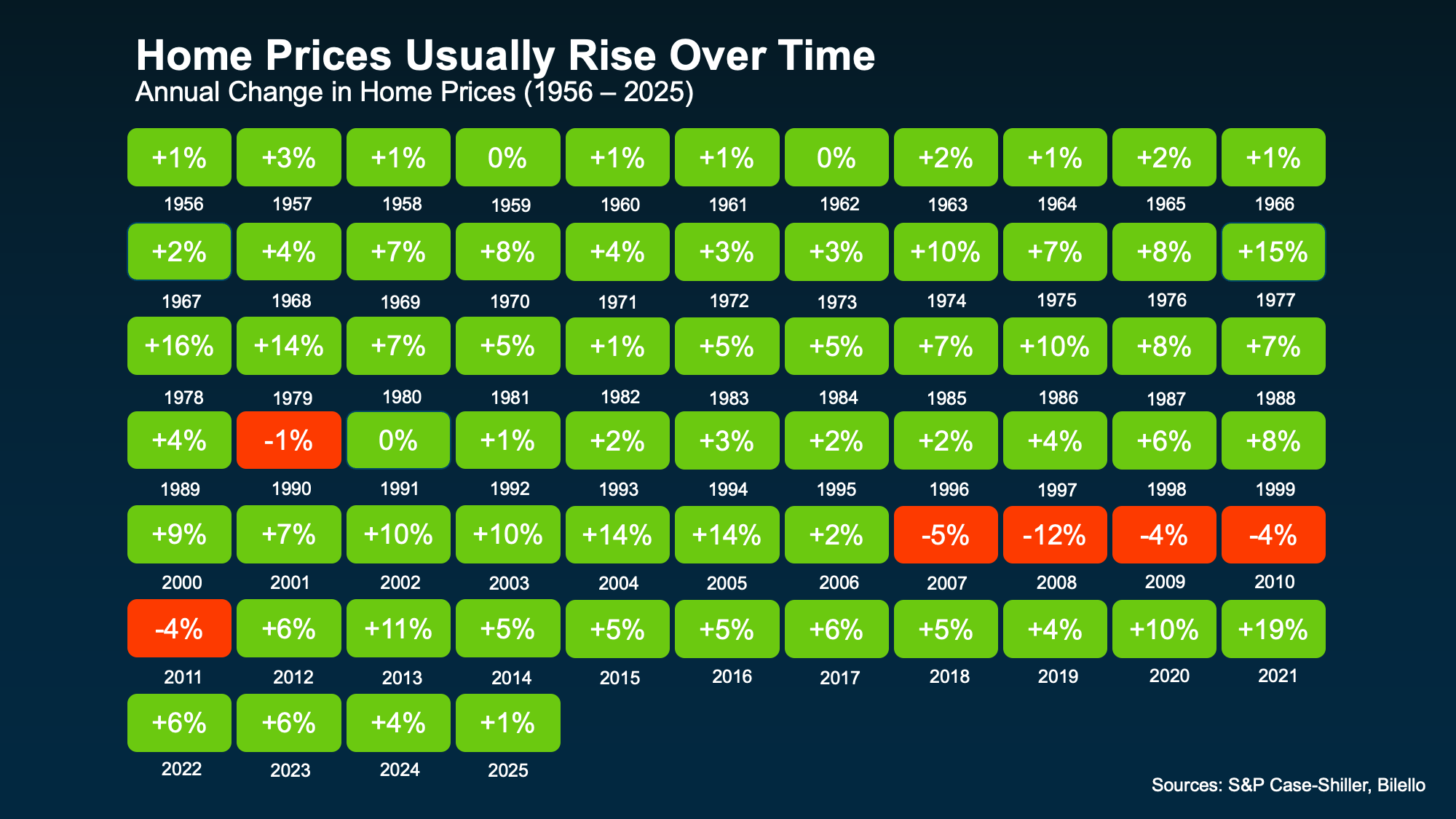 That’s a remarkably consistent track record. And it shows something a lot of headlines miss.
While short-term shifts can happen, it’s the long-term gains that really matter.
Why Prices Tend To Rise Over Time
There are a few core reasons prices usually go up each year:
- There are always people who need to move. People need a place to live, and that demand will never fully go away. It may ebb and flow, but someone will always have to move as big changes happen in their life. So, homes stay in demand.
- There still aren’t enough homes for sale. While the number of homes for sale has grown, nationally there’s still an undersupply based on how many people want a home. That keeps upward pressure on prices.
- Inflation has an impact. Over time, the cost of goods (including homes) naturally increases. That pushes home values higher.
What That Means for You as a Buyer
It’s easy to get caught up in what might happen with home prices next month or next year, especially if you’re a first-time buyer and you’re feeling a little anxious about making such a big financial commitment. But the big picture is clear. Prices usually rise.
That doesn’t mean prices will go up every single year in every market. Real estate is local, and there can be short-term ups and downs. We’re seeing that in some places right now. You can even see it in the few annual dips in the visual above.
But historically, the declines have been temporary.
That’s why it’s generally recommended to buy a home only if you plan to stay for a while – typically at least five years. That’s normally enough time to see your house grow in value. And, it’s enough so you can ride out any short-term changes in the market.
Because when you can do that, something powerful happens. Those rising home values grow your net worth, and by extension, help you build wealth.
The right decision isn’t about timing the market perfectly. It’s about making a move that works for your life and staying in it long enough to benefit from the bigger trend.
Bottom Line
Home prices have a long track record of going up over time. And that’s why buying a home is generally considered a safe long-term investment.
That certainly doesn’t mean you have to buy now. You should only move when it makes sense, and you plan to live there for a while.
But if you’re interested, let this reassure you. If you want to talk through what home prices are doing in our market, your goals, or your timelines, let’s have a quick conversation.
Thank You For Reading
Denise Olivares-Molina

by Denise Olivares-Molina | Feb 16, 2026 | For Buyers, Home Buying, Home Preparation, Home Prices, Home value, Housing Market, Investment, Investment Strategy, Investments, Move-up Buyers, Weekly
At some point, a house that once felt perfect just… doesn’t anymore.
Maybe you need more space.
Maybe working from home turned your dining room into a permanent office.
Maybe the layout just doesn’t match how you live now.
If your current house is starting to feel like it’s holding you back instead of supporting your life, it’s natural to think about making a move. But that brings up the next big question: once you sell, where do you go?
For a growing number of buyers, the answer is something brand new.
New Construction Is a More Popular Choice Lately
According to the National Association of Realtors (NAR), more people are buying new homes than they have in years. The latest annual data available shows 16% of homes purchased were newly built.
At first glance you may not see why that’s a big deal. But that’s actually the highest share of new home purchases in almost two decades.
Why More Buyers Are Choosing a Brand-New Construction
For many buyers, especially move-up buyers, new construction isn’t just about aesthetics. It’s about lifestyle, convenience, and peace of mind.
1. Everything Is Brand New
You’re not inheriting someone else’s projects. No wondering how old the roof is. No budgeting for a new HVAC right after move-in. No big surprises when the previous owners patch job fails. For move-up buyers who’ve been dumping money into updating their current house, that’s a win.
2. You Can Customize Before Move In
If you choose a home that’s still under construction, you could have the chance to pick the flooring, counters, cabinets, hardware, lighting, and so much more. That level of personalization can be a draw for move-up buyers like you, because it allows you to hand pick the fit and finishes you’ve been wanting for so long.
3. A Home Designed for How People Live Today
Most new construction homes are built to current building standards and buyer preferences, which means you could see built-in smart home features, better energy efficiency (which can lower utility bills), and even more modern floor plans and features. And if your layout just isn’t working for you anymore, you may find exactly what you need now in a new home.
4. Neighborhood Amenities
New developments often include shared community spaces like walking trails, parks, playgrounds, or even pools and gyms. For families and active households, that’s a big bonus to have that just a few steps out of their front door.
5. Builder Incentives
Not to mention, since there are more new homes on the market than the norm, builders are motivated to sell what they have. So, you may find they’re more willing to negotiate than you’d expect on things like price, upgrades, and more.
Bottom Line
If your current house isn’t meeting your needs anymore, don’t assume your only choice is an existing home. New construction is becoming a real contender, especially for move-up buyers who want space, features, and a home that works for how they live now.
Curious whether new construction might be a fit for you? Let’s chat.
Thank You For Reading
Denise Olivares-Molina

by Denise Olivares-Molina | Jan 13, 2026 | Advice for Sellers, Affordability, For Sellers, Home Buying, Home Care, Home Equity Loans, Home Gain Statistics, Home Preparation, Home Prices, Home value, Homeowner Information, Housing Market, Housing Market Shifts, Housing Market Updates, Investment, Investment Strategy, Investments, Pricing, Real Estate Finances, Real Estate Goals, Real Estate Investing, Real Estate Market, Real Estate Tips, Real Estate Trends in 2026, Seller, Sellers, Selling A Home, Selling Myths, Selling Tips, Weekly
¿Te preguntas qué esperar del mercado inmobiliario en 2026? No eres el único. Durante los últimos años, la asequibilidad ha sido la mayor barrera entre la mayoría de las personas y su próxima mudanza. Y muchos compradores y vendedores han estado conteniendo la respiración esperando que las cosas mejoren. ¿La buena noticia? Finalmente está sucediendo.
En 2025, la asequibilidad fue la mejor de los últimos 3 años. Y los expertos coinciden en que este impulso continuará en 2026. Esto se basa en su análisis de los factores clave que darán forma al mercado de la vivienda el próximo año: las tasas hipotecarias, el inventario y los precios de las viviendas.
Las tasas hipotecarias más bajas ya están aquí
Las tasas hipotecarias ya han bajado desde su punto máximo. Según algunos cálculos, cayeron casi un punto porcentual completo en el último año. Y eso es algo importante, aunque no lo parezca. Pero, ¿qué tan bajo llegarán? ¿Y deberías esperar a que bajen más? Aquí tienes la respuesta.
Los pronósticos sugieren que se mantendrán prácticamente donde están ahora y oscilarán en el rango bajo del 6% a lo largo de 2026 (ver gráfico a continuación):
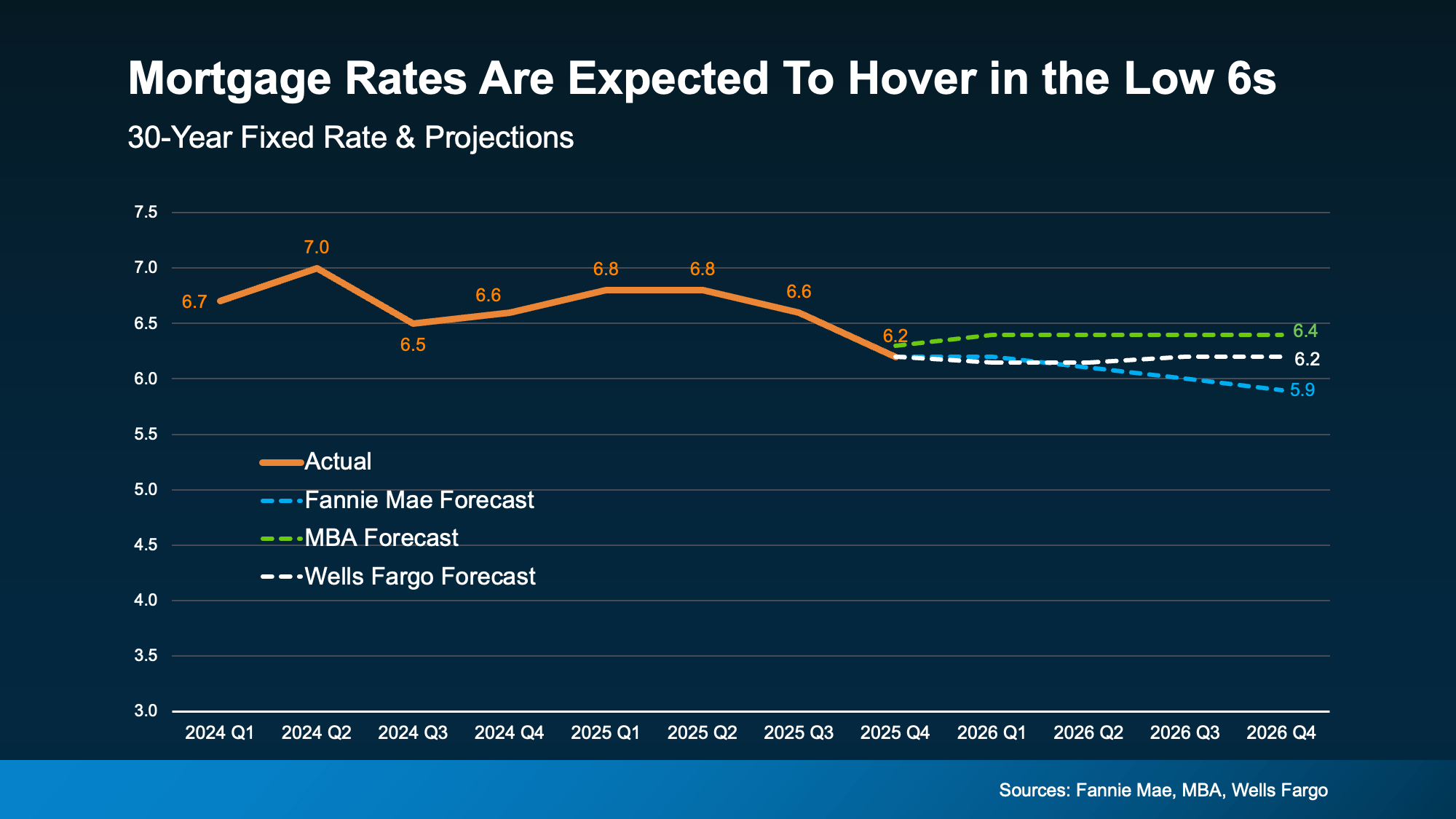
Hacia dónde vayan a partir de aquí realmente depende de lo que suceda con la economía, el mercado laboral y cualquier cambio en la política monetaria que haga la Reserva Federal (Fed) el próximo año. Lo importante es que ya son más bajas de lo que eran hace solo un año, y eso es ideal si estás planeando mudarte en 2026.
-
Para los compradores: Una tasa más baja reduce los pagos mensuales y aumenta el poder adquisitivo. Y esa combinación ayuda a que más personas califiquen para hogares que antes sentían fuera de su alcance.
-
Para los vendedores: Puede ser hora de aceptar que las tasas en el rango del 6% son la nueva normalidad. Y si necesitas mudarte, es factible, especialmente con tu plusvalía (equity).
Vienen aún más opciones en camino
En 2025, el número de viviendas en venta mejoró aproximadamente un 15%. A medida que aumentó el inventario, los compradores recuperaron cosas que no habían tenido en años: opciones, tiempo para considerar esas opciones y poder de negociación. Eso ayudó a restaurar un mayor equilibrio en el mercado inmobiliario.
Sin mencionar que el aumento del inventario es una gran parte de lo que ha ayudado a que el crecimiento de los precios se desacelere, lo que a su vez mejora la asequibilidad.
Si bien no se espera que el aumento de inventario este año sea tan pronunciado, los expertos de Realtor.com dicen que la oferta de viviendas en venta debería crecer otro 8.9% este año.
El crecimiento de los precios de las viviendas se desacelera a un ritmo más sostenible
Con más viviendas en venta, no hay tanta presión al alza sobre los precios en este momento. Y hemos visto cómo eso se ha estabilizado durante el último año. Aun así, la abrumadora mayoría de los expertos dicen que, a nivel nacional, los precios seguirán subiendo el próximo año, solo que a un ritmo más lento. En promedio, dicen que los precios subirán un 1.6% en 2026 (ver gráfico a continuación):
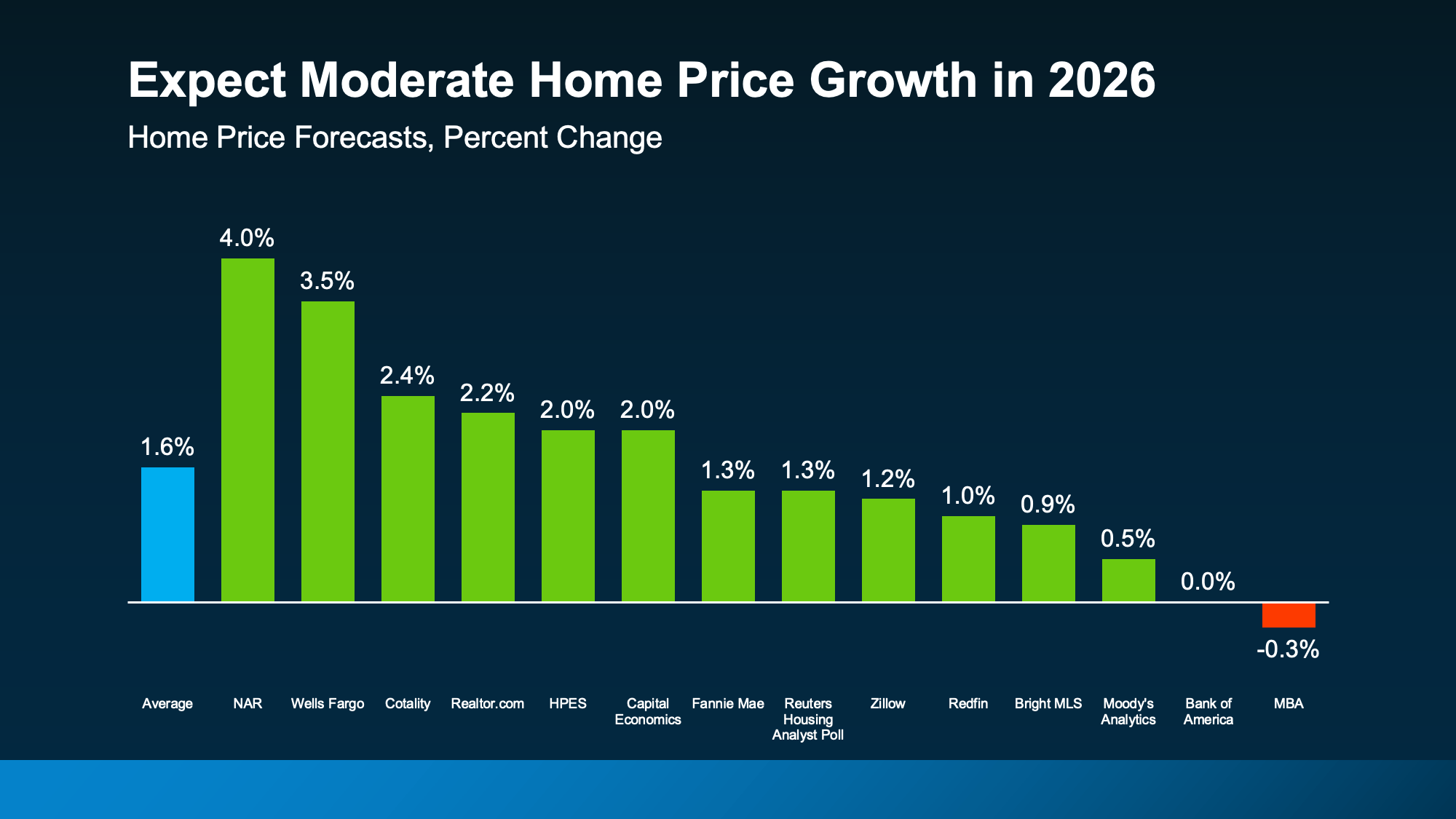
Y eso es tranquilizador si has estado viendo contenido en las redes sociales que dice que los precios se van a desplomar. Pero esto es lo que más debes recordar al respecto: Va a variar mucho según la zona.
Por lo tanto apóyate en un agente local para conocer lo último sobre lo que está sucediendo donde vives. Algunos mercados verán subir los precios más que esto. Otros pueden ver bajar los precios ligeramente. Todo depende realmente de las condiciones en tu mercado local.
Pero en general, los precios continuarán subiendo a nivel nacional. Y eso es bueno para el mercado en su conjunto. Como explica Realtor.com:
“Para los compradores y vendedores de viviendas, el cambio señala un mercado más equilibrado: uno donde el crecimiento de los precios se estabiliza, el alivio de las tasas ofrece un respiro y el poder de negociación se inclina sutilmente hacia los compradores.”
-
Para los compradores: Esperen un crecimiento de precios más moderado, no los picos repentinos e intensos de hace unos pocos años. Eso les da menos sorpresas y más previsibilidad, lo que facilita mucho la elaboración del presupuesto.
-
Para los vendedores: Este crecimiento más lento de los precios restaura el equilibrio sin poner en riesgo su plusvalía. Y eso es una victoria.
Se venderán más viviendas
Todo esto suma para una mejor ecuación de asequibilidad en 2026. Y esa es exactamente la razón por la que los expertos dicen que deberíamos ver venderse más viviendas (y más gente comprando) este año.
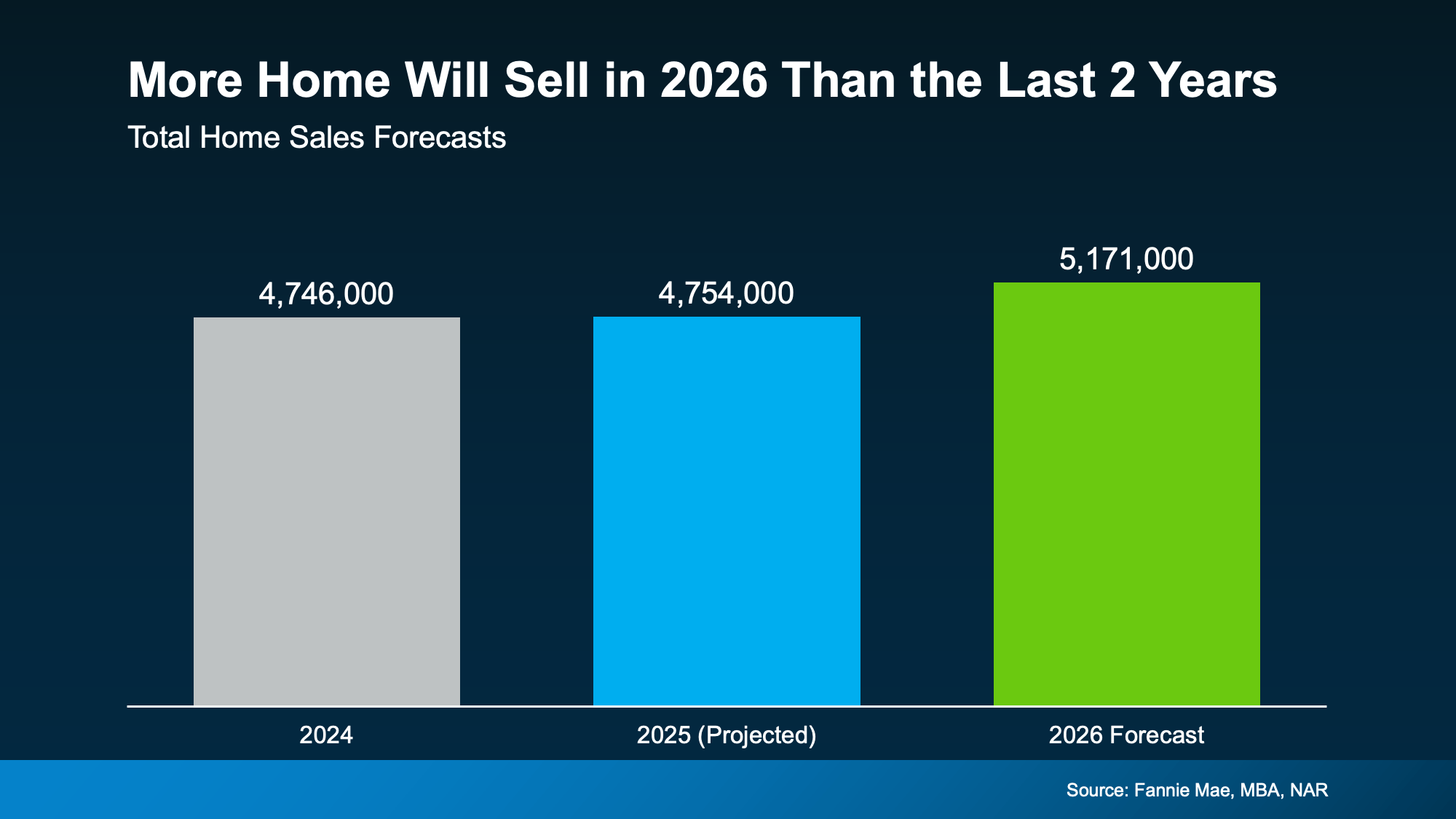
Como dice Mischa Fisher, Economista Jefe de Zillow:
“Los compradores se están beneficiando de más inventario y una mejor asequibilidad, mientras que los vendedores están viendo estabilidad de precios y una demanda más constante. Cada grupo debería tener un poco más de margen de maniobra en 2026.”
El punto es que, finalmente, más personas podrán hacer su mudanza este año. Entonces, la pregunta es: ¿serás tú uno de ellos? El mercado te está dando una oportunidad que no has tenido en un tiempo. Tal vez sea hora de aprovecharla.
En conclusión
La asequibilidad no cambiará repentinamente de la noche a la mañana. Pero, con varias tendencias clave trabajando juntas, debería mejorar lenta y constantemente en los próximos meses.
Es exactamente por eso que, en 2026, deberías ver un mercado con más equilibrio, más previsibilidad y más margen de maniobra del que has tenido en años.
¿Quieres más información sobre las oportunidades que se abren en nuestro mercado local? Hablemos.
Gracias Por Leer
Denise Olivares-Molina

by Denise Olivares-Molina | Jan 13, 2026 | Advice for Sellers, Affordability, Current Trends, For Sellers, Forecasts, Home Prices, Home value, Homeowner Information, Housing Market, Housing Market Updates, Investment, Investment Strategy, Investments, Real Estate Finances, Real Estate Goals, Real Estate Investing, Real Estate Market, Real Estate Tips, Real Estate Trends in 2026, Weekly
Wondering what to expect from the housing market in 2026? You’re not the only one. For the past few years, affordability has been the biggest barrier standing between most people and their next move. And a lot of buyers and sellers have been holding their breath waiting for things to get better. The good news? It’s finally happening.
In 2025, affordability was the best it’s been in 3 years. And experts agree the momentum will keep going in 2026. And that’s based on their analysis of the key factors shaping the housing market in the year ahead: mortgage rates, inventory, and home prices.
Lower Mortgage Rates Are Already Here
Mortgage rates have already come down from their peak. By some counts, they dropped by almost a full percentage point over the course of the last year. And that’s a big deal, even if it doesn’t sound like it. But how low will they go? And should you wait for them to come down more? Here’s your answer.
Forecasts suggest they’ll stay pretty much where they are now and hover in the low 6% range throughout 2026 (see graph below):
Where they go from here really depends on what happens with the economy, the job market, and any changes in monetary policy the Fed makes in the year ahead. The important thing is, they’re already lower than they were just one year ago and that’s ideal if you’re planning a 2026 move.
- For buyers: A lower rate reduces monthly payments and increases buying power. And, that combo helps more people qualify for homes that previously felt just out of reach.
- For sellers: It may be time to accept that rates in the 6s are the new normal. And if you need to move, it’s doable, especially with your equity.
Even More Options Are on the Way
In 2025, the number of homes for sale improved by about 15%. As inventory rose, buyers regained things they hadn’t had in years: options, time to consider those options, and negotiating leverage. That helped restore more balance to the housing market.
Not to mention, the inventory gains are a big piece of what’s helped price growth slow down – which in turn improves affordability.
While the inventory gains this year aren’t expected to be as steep, experts at Realtor.com say the supply of homes for sale should grow by another 8.9% this year.
- For buyers: That means even more choice and more negotiating power.
- For sellers: Pricing your house right will be essential to draw in buyers.
Home Price Growth Is Slowing to a More Sustainable Pace
With more homes for sale, there isn’t as much upward pressure on prices right now. And we’ve seen that shake out over the past year. Even so, the overwhelming majority of experts say, nationally, prices will continue rising in the year ahead – just at a slower pace. On average, they say prices will rise by 1.6% in 2026 (see graph below):
And that’s reassuring if you’ve been fed content on social media saying prices are going to come crashing down. But here’s what you need to remember most about this. It’s going to vary a lot by area.
So, lean on a local agent for the latest on what’s happening where you are. Some markets will see prices rise more than this. Others may see prices come down slightly. It really all depends on conditions in your local market
But overall, prices will continue to rise at the national level. And that’s good for the market as a whole. As Realtor.com explains:
“For homebuyers and sellers, the shift signals a more balanced market—one where price growth steadies, rate relief offers breathing room, and negotiating power tilts subtly toward buyers.”
- For buyers: Expect more moderate price growth, not the sudden and intense spikes just a few short years ago. That gives you fewer surprises and more predictability, which makes budgeting a whole lot easier.
- For sellers: This slower price growth restores balance without putting your equity at risk. And that’s a win.
More Homes Will Sell
All of this adds up to a better affordability equation in 2026. And that’s exactly why experts are saying we should see more homes sell (and more people buy) this year.
As Mischa Fisher, Chief Economist at Zillow, says:
“Buyers are benefiting from more inventory and improved affordability, while sellers are seeing price stability and more consistent demand. Each group should have a bit more breathing room in 2026.”
The bottom line is, more people are finally going to be able to make their move this year. So, the question is: will you be one of them? The market is giving you an opportunity you haven’t had in a while. Maybe it’s time to take advantage of it.
Bottom Line
Affordability won’t change suddenly overnight. But, with several key trends working together, it should slowly and steadily improve in the months ahead.
That’s exactly why, in 2026, you should see a market with more balance, more predictability, and more breathing room than you’ve had in years.
Want more information about the opportunities unlocking in our local market?
Let’s chat.
Thank You For Reading
Denise-Olivares-Molina

by Denise Olivares-Molina | Jul 15, 2025 | Buying Tips, For Buyers, Investment, Real Estate 2025, Weekly

There are plenty of headlines these days calling for a housing market crash. But the truth is, they’re not telling the full story. Here’s what’s actually happening, and what the experts project for home prices over the next 5 years. And spoiler alert – it’s not a crash.
Yes, in some local markets, prices are flattening or even dipping slightly this year as more homes hit the market. That’s normal with rising inventory. But the bigger picture is what really matters, and it’s far less dramatic than what the doom-and-gloom headlines suggest. Here’s why.
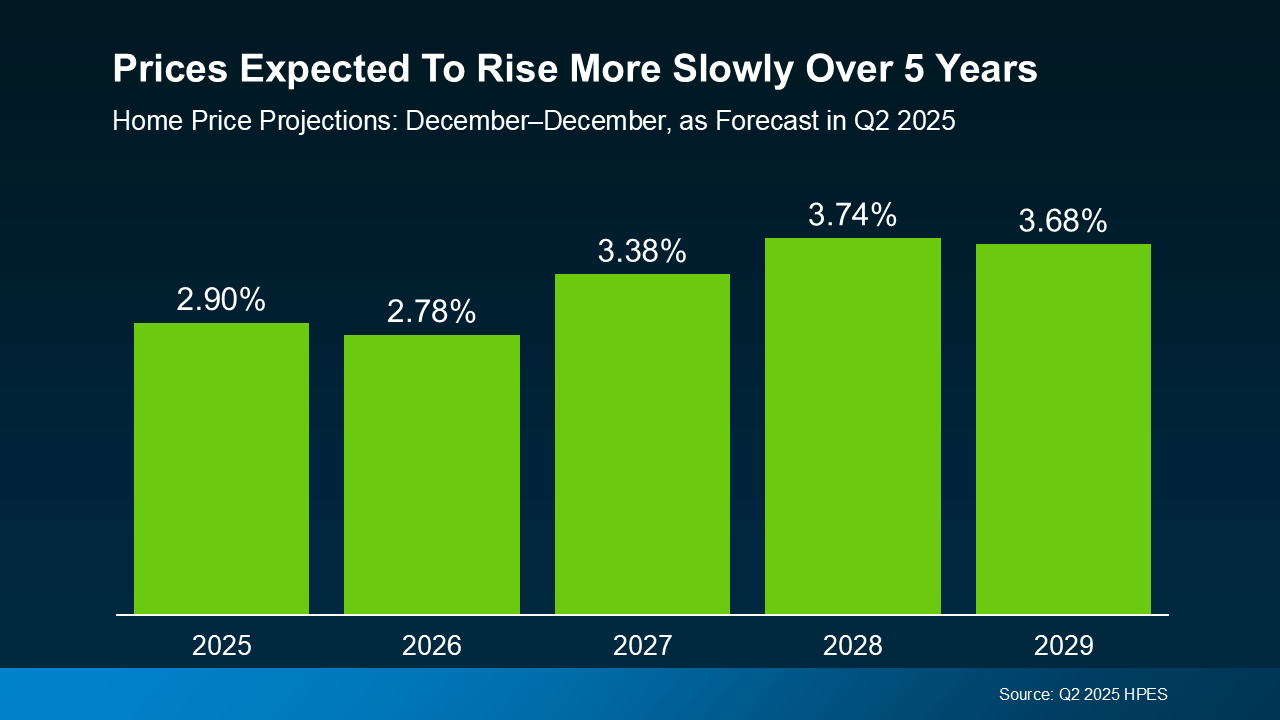
Over 100 leading housing market experts were surveyed in the latest Home Price Expectations Survey (HPES) from Fannie Mae. Their collective forecast shows prices are projected to keep rising over the next 5 years, just at a slower, healthier pace than what we’ve seen more recently. And that kind of steady, sustainable growth should be one factor to help ease your fears about the years ahead (see graph below):
 And if you take a look at how the various experts responded within the survey, they fall into three main categories: those that were most optimistic about the forecast, most pessimistic, and the overall average outlook.
Here’s what the breakdown shows:
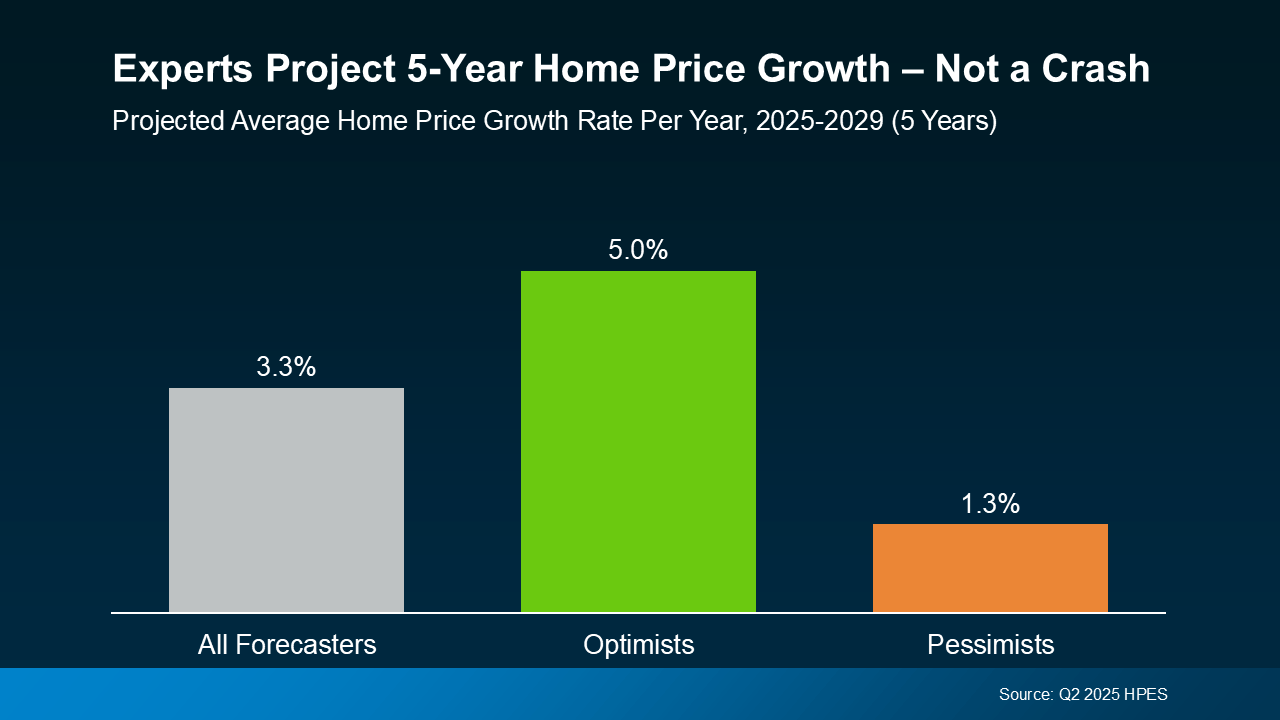
- The average projection is about 3.3% price growth per year, through 2029.
- The optimists see growth closer to 5.0% per year.
- The pessimists still forecast about 1.3% growth per year.
Do they all agree on the same number? Of course not. But here’s the key takeaway: not one expert group is calling for a major national decline or a crash. Instead, they expect home prices to rise at a steady, more sustainable pace.
That’s much healthier for the market – and for you. Yes, some areas may see prices hold relatively flat or dip a bit in the short term, especially where inventory is on the rise. Others may appreciate faster than the national average because there are still fewer homes for sale than there are buyers trying to purchase them. But overall, more moderate price growth is cooling the rapid spikes we saw during the frenzy of the past few years.
And remember, even the most conservative experts still project prices will rise over the course of the next 5 years. That’s also because foreclosures are low, lending standards are in check, and homeowners have near record equity to boost the stability of the market. Together, those factors help prevent a wave of forced sales, like the kind that could drag prices down. So, if you’re waiting for a significant crash before you buy, you might be waiting quite a long time.
Bottom Line
If you’ve been on the fence about your plans, now’s the time to get clarity. The market isn’t heading for a crash. It’s on track for steady, slow, long-term growth overall, with some regional ups and downs along the way.
Want to know what that means for our neighborhood? Because national trends set the tone, but what really matters is what’s happening in your zip code.Let’s have a quick conversation so you can see exactly what our local data means for you.

by Denise Olivares-Molina | Jul 1, 2025 | For Buyers, Investment, Real Estate 2025, Real Estate Tips, Weekly

Multi-generational living is on the rise. According to the National Association of Realtors (NAR), 17% of homebuyers purchase a home to share with parents, adult children, or extended family. That’s the highest share ever recorded by NAR (see graph below):
 And what’s behind the increase? Affordability. NAR explains:
“In 2024, a notable 36% of homebuyers cited “cost savings” as the primary reason for purchasing a multigenerational home—a significant increase from just 15% in 2015.”
In the past, caregiving was the leading motivator – especially for those looking to support aging parents. And while that’s still important, affordability is now the #1 motivator. And with current market conditions, that’s not really a surprise.
Pooling Resources Can Help Make Homeownership Possible
With today’s home prices and mortgage rates, it can be hard for people to afford a home on their own. That’s why more families are teaming up and pooling their resources.
By combining incomes and sharing expenses like the mortgage, utility bills, and more, multi-generational living offers a way to overcome financial challenges that might otherwise put homeownership out of reach. As Rick Sharga, Founder and CEO at CJ Patrick Company, explains:
“There are a few ways to improve affordability, at least marginally. . . purchase a property with a family member — there are a growing number of multi-generational households across the country today, and affordability is one of the reasons for this.”
But this strategy doesn’t just help with affordability. It may even allow you to get a larger home than you’d qualify for on your own and that gives everyone a bit more breathing room. As Chris Berk, VP of Mortgage Insights at Veterans United, explains:
“Multigenerational homes are more than a trend: They are a meaningful solution for families looking to care for one another while making the most of their homebuying power.”
And momentum may be growing. Nearly 3 in 10 (28%) of homebuyers say they’re planning to purchase a multi-generational home.
Maybe it’s a solution that would make sense for you too. The best way to find out? Talk to a local real estate agent who can help you decide if this option would work for you.
Bottom Line
If your budget feels tight, buying a multi-generational home could be a smart solution.
Would you ever consider buying a home with a family member? Why or why not?
Let’s connect to talk through your options.
