
by Denise Olivares-Molina | Aug 17, 2026 | Advice for Homeowners, Advice for Sellers, For Sellers, Home Selling Strategy, Home value, Homeowner Information, Housing Market, Housing Market Insights, Housing Market Shifts, Seller, Sellers, Selling A Home, Selling Tips, Weekly
Esa habitación de sobra en la planta principal. El sótano terminado con una pequeña cocina y su propia entrada. La habitación extra que ha estado usando como depósito.
Para usted, es espacio extra. Pero para un grupo cada vez mayor de compradores, es la razón por la que elegirían su casa. Aquí le explicamos por qué. La compra de viviendas multigeneracionales va en aumento.
Millones de familias viven de forma multigeneracional
El número de hogares multigeneracionales está aumentando. Esto sucede cuando 3 o más generaciones viven bajo un mismo techo. Y los datos muestran que esos hogares crecieron de 3,2 millones a casi 4 millones entre 2014 y 2024, según Realtor.com.
Y cada año, más personas buscan una casa más grande que se adapte a sus necesidades combinadas.
Si bien el interés por este tipo de casa está aumentando a nivel general, los datos de USAFacts muestran que la convivencia multigeneracional es más común en unos estados que en otros. Cuanto más oscuro sea el estado en el mapa a continuación, más común es en esa área (consulte el mapa a continuación):
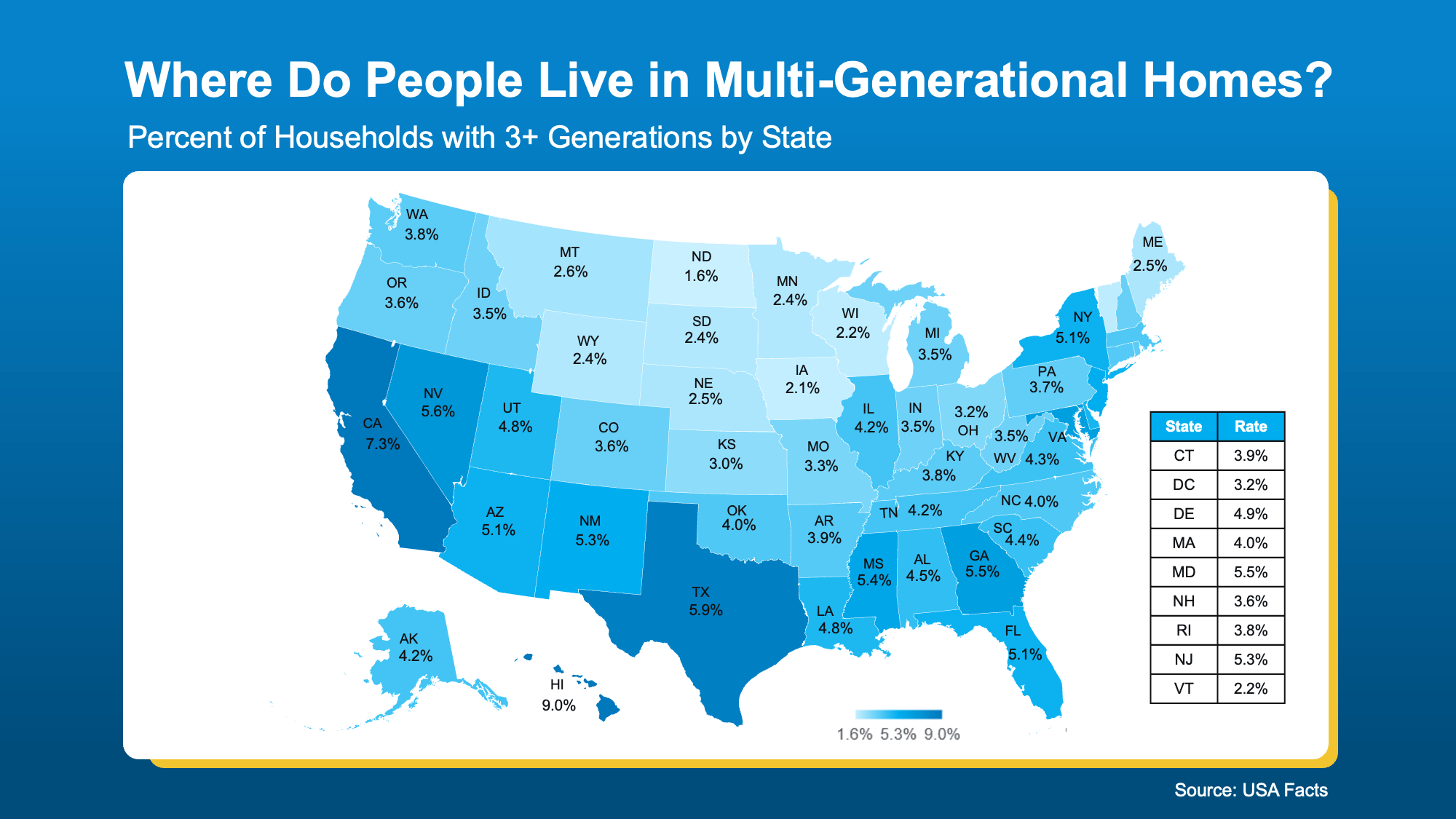
¿Dónde se ubica su estado? Dependiendo de dónde se encuentre, el grupo de compradores que busca una casa como la suya podría ser incluso más grande de lo que piensa. Pero la conclusión general es la siguiente:
Existe un mercado real para las casas más grandes con espacio para múltiples generaciones bajo un mismo techo, especialmente porque la asequibilidad de las viviendas sigue siendo muy ajustada. Y si usted es dueño de una casa así, sepa que tiene mucha demanda.
Las casas multigeneracionales se venden a un precio superior
Y esa habitación adicional tiene un valor real para el comprador adecuado. Según Realtor.com, en 2025, el precio promedio de venta de una casa multigeneracional fue de $709.000, aproximadamente un 65% más alto que el promedio de $429.900 de una casa estándar.
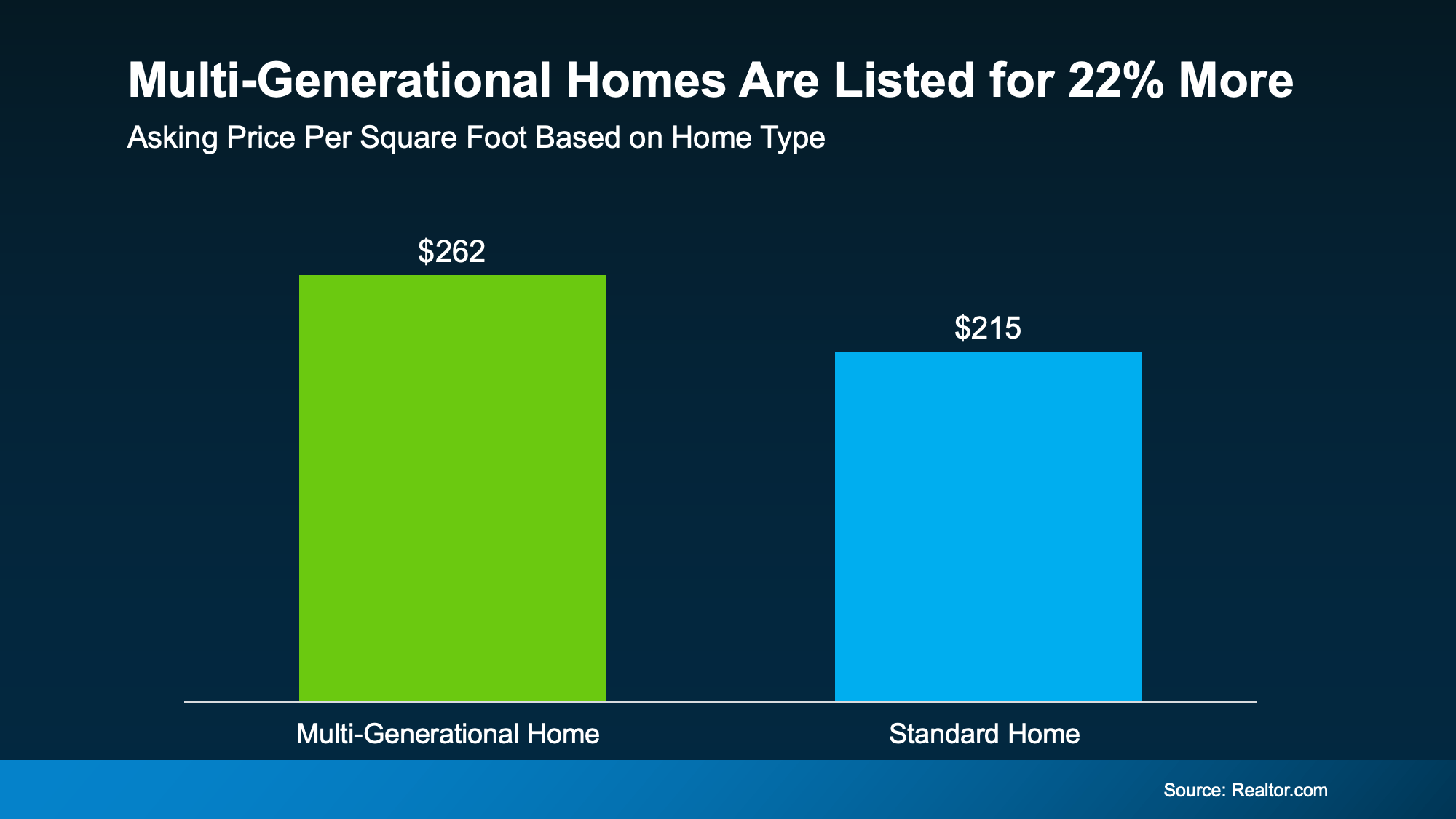
Parte de esto se debe simplemente al tamaño. Pero si comparamos las casas multigeneracionales con las casas normales que tienen la misma cantidad de pies cuadrados, las primeras siguen ganando: $262 por pie cuadrado en comparación con $215.
Ese es un recargo del 22% que podría obtener por características especiales como suites para suegros, segundas cocinas y entradas independientes (consulte el gráfico a continuación):
Cuando venda, esto podría ayudarle a quedarse con más dinero en el bolsillo, especialmente cuando su agente inmobiliario destaque las características multigeneracionales de su casa en el anuncio.
Y los compradores no se asustan con los precios
E incluso con precios ligeramente más altos, los compradores no se echan atrás. Las casas multigeneracionales atrajeron un 13,5% más de visitas en línea que las estándar y, aun así, se vendieron igual de rápido (en unos 59 días), según el mismo informe de Realtor.com.
Hannah Jones, analista sénior de investigación económica en Realtor.com, explica:
“La fuerte demanda y los elevados precios superiores que estamos viendo en mercados con inventario limitado apuntan a un verdadero desajuste entre lo que los compradores buscan y lo que realmente está disponible. Para los vendedores en estos mercados, este tipo de vivienda puede ser un activo importante”.
Básicamente, cuando los compradores quieren algo muy específico, la casa que cumple con esos requisitos tiende a destacar.
En conclusión
Su casa, adaptada para varias generaciones o simplemente más grande que el promedio, podría cumplir con criterios que muchos compradores no encuentran en una vivienda estándar. Eso es lo que llama la atención. Y lo que genera ofertas. Así que, hablemos sobre lo que podría obtener en nuestro mercado en este momento.
Gracias por leer,
Denise Olivares-Molina

by Denise Olivares-Molina | Aug 17, 2026 | Advice for Homeowners, Advice for Sellers, For Sellers, Home Prices, Home Selling Strategy, Homeowner Information, Housing Market, Housing Market Insights, Real Estate Finances, Real Estate Investing, Real Estate Market, Real Estate Market 2026, Real Estate Tips, Real Estate Trends in 2026
That spare room on the main floor. The finished basement with a kitchenette and its own entrance. The bonus room you’ve been using for storage.
To you, it’s extra space. But to a growing pool of buyers, it’s the reason they’d pick your house. Here’s why. Multi-generational homebuying is on the rise.
Millions of Families Are Living Multi-Generationally
The number of multi-generational households is climbing. That’s when 3 or more generations live under one roof. And data shows those households grew from 3.2 million to almost 4 million between 2014 and 2024, according to Realtor.com.
And each year, more people are shopping for a larger home that fits their combined needs.
While the appetite for this type of house is rising across the board, data from USAFacts shows multi-generational living is more common in some states than others. The darker the state in the map below, the more common it is in that area (see map below):
Where does your state fall? Depending on where you are, the pool of buyers looking for a house like yours could be even bigger than you’d think. But the overall bottom line is this.
There’s a real market out there for larger homes with room for multiple generations under one roof, especially since affordability is still so tight. And if you own a house like that, it’s in demand.
Multi-Generational Houses Sell at a Premium
And that extra room carries real value with the right buyer. According to Realtor.com, in 2025 the median asking price for a multi-generational house was $709,000 – roughly 65% higher than the $429,900 median for a standard house.
Some of that is simply size. But compare multi-generational homes to regular homes with the same amount of square footage, and they still come out on top – $262 per square foot versus $215.
That’s a 22% premium you could command for special features like in-law suites, second kitchens, and separate entries (see graph below):
When you sell, this could help you walk away with more money in your pocket, especially when your agent highlights your home’s multi-generational-friendly features in your listing.
And Buyers Aren’t Getting Sticker Shock
And even with slightly higher price tags, buyers aren’t flinching. Multi-generational houses drew 13.5% more online views than standard ones, and they still sold just as fast – in about 59 days – per the same Realtor.com report.
Hannah Jones, Senior Economic Research Analyst at Realtor.com, explains:
“The strong demand and steep premiums we are seeing in inventory-constrained markets point to a real mismatch between what buyers are looking for and what is actually available. For sellers in these markets, this type of home can be a significant asset.”
Basically, when buyers want something that’s very specific, the house that checks the box tends to stand out.
Bottom Line
Your multi-generational-friendly, or simply larger-than-average, house might meet criteria a lot of buyers can’t find in a standard one. That’s what gets attention. And offers. So, let’s chat about what it could get you in our market right now.
Thank You For Reading
Denise Olivares-Molina

by Denise Olivares-Molina | Aug 3, 2026 | Advice for Buyers, Advice for Homeowners, Buyers, Buying A Home, For Buyers, Homeowner Information, Weekly
Si comprar una casa está en tu radar, probablemente has estado atento a las tasas hipotecarias y los precios de las viviendas. Pero no te olvides del seguro de vivienda.
El seguro de vivienda siempre ha sido parte de ser propietario de una casa. Sin embargo, en los últimos años, se ha convertido en un gasto mayor para muchos propietarios, algo que es especialmente frustrante cuando la asequibilidad ya se siente ajustada.
¿Las buenas noticias? Aunque las primas siguen subiendo, los datos más recientes muestran que esos aumentos están empezando a desacelerar. Esto es lo que los compradores deben saber.
Los costos del seguro de vivienda han aumentado
Probablemente has escuchado historias de amigos o familiares sobre el aumento de sus primas. Y eso no es realmente una sorpresa si consideras que los datos del Pew Research Center muestran que el 71 % de los propietarios afirman que los costos de sus seguros han aumentado en los últimos años.
Aunque a nadie le gustan los costos crecientes, saber qué esperar puede ayudarte a planificar con anticipación. Tu primer pago del seguro suele estar incluido en los costos de cierre, pero después de eso se convertirá en parte de tus gastos mensuales de vivienda.
Obtener una cotización de seguro con anticipación puede ayudarte a crear un presupuesto más realista y evitar sorpresas más adelante.
Las primas están subiendo, pero no tan rápido como antes
La mayoría de los titulares se centran en cómo el seguro de vivienda se está volviendo más caro. Y es verdad. Pero esta es la parte que es fácil pasar por alto:
Las primas de los seguros siguen subiendo.
Pero no están subiendo tan rápido como antes.
Según el informe más reciente de Rate Insurance, en 2025 se observó la primera desaceleración en los aumentos anuales de las primas desde 2019 (ver gráfico a continuación):
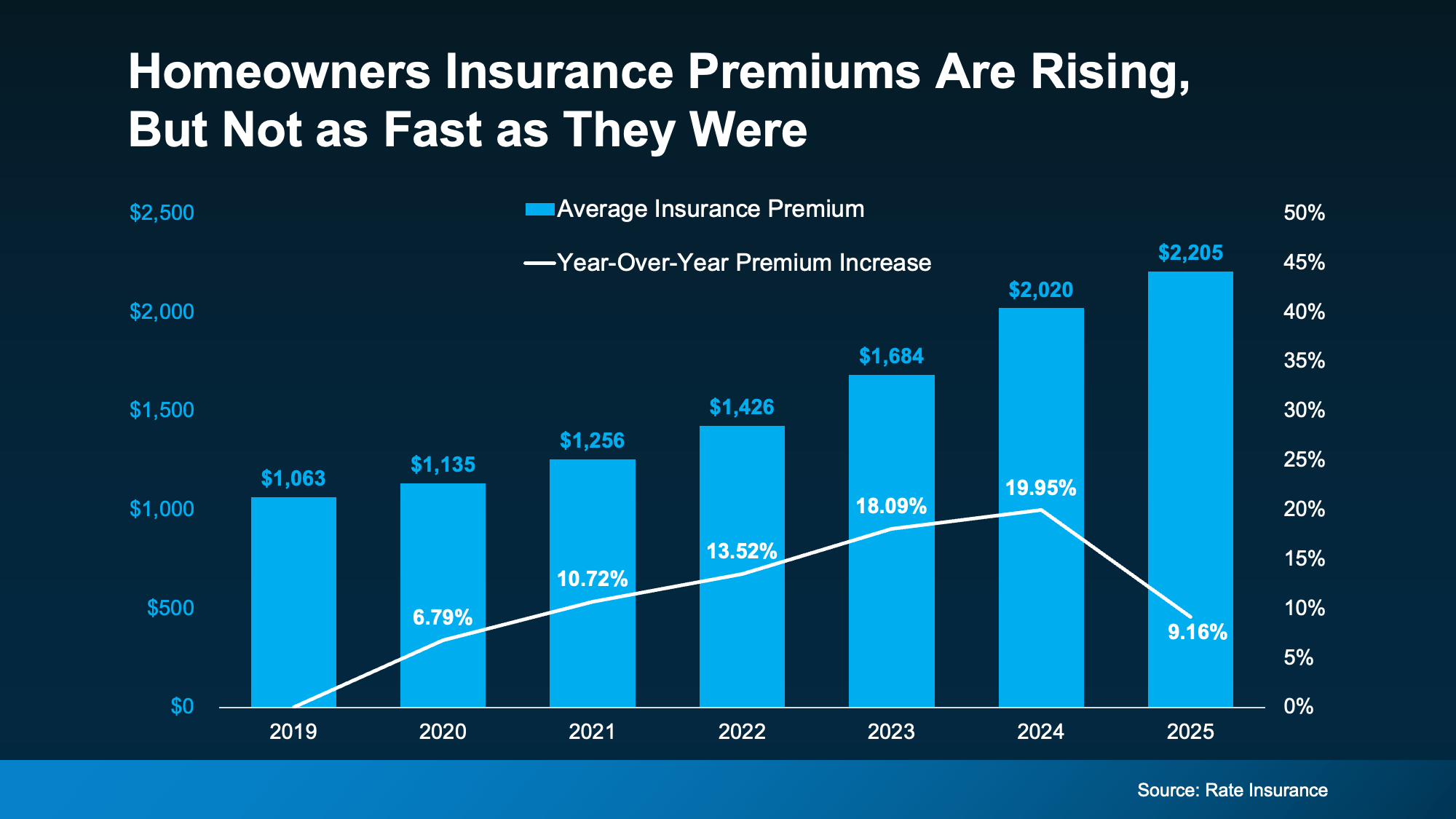
Eso no significa que las primas se estén volviendo más baratas. Simplemente significa que los rápidos aumentos de los últimos años podrían estar finalmente empezando a moderarse, un paso pequeño pero bienvenido en la dirección correcta.
Pero lo que pagarás en una parte del país puede ser muy diferente de lo que alguien paga en otro lugar.
El lugar donde compres puede marcar una gran diferencia
Los costos del seguro varían porque algunas partes del país experimentan más reclamos que otras. Por eso es importante observar lo que sucede a nivel local.
Tu prima dependerá de factores como el lugar donde estás comprando, la vivienda en sí y la cobertura que elijas.
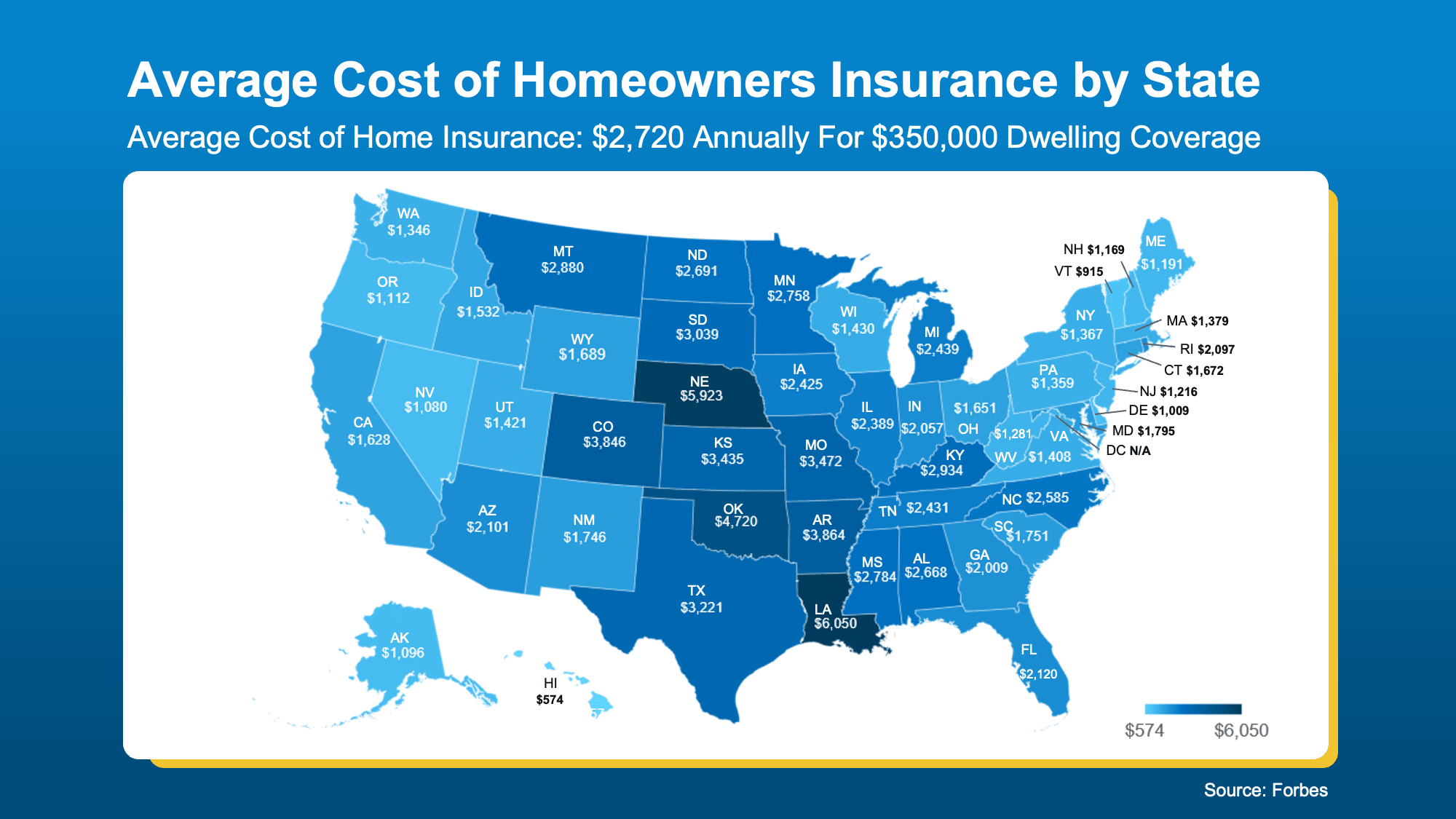
Los datos de Forbes pueden darte una idea aproximada de las primas típicas de tu estado. Echa un vistazo al mapa a continuación: cuanto más oscuro sea el azul, más altos tienden a ser los costos en ese estado:
Formas de reducir tus costos
Si bien no puedes controlar cada gasto que conlleva comprar una casa, sí puedes controlar qué tan preparado estás. Si estás haciendo cuentas y tratando de encontrar formas de ahorrar, Insurify y NerdWallet ofrecen estos consejos que pueden ayudarte a conseguir el mejor precio de seguro posible:
-
Busca opciones: Compara cotizaciones de varias compañías.
-
Agrupa tus pólizas: Combina los seguros de vivienda y de auto para ver si el precio en paquete es más económico.
-
Pregunta por descuentos: No te pierdas los ahorros para los que podrías calificar.
-
Destaca las mejoras: Características como un techo nuevo o ventanas contra tormentas pueden reducir los costos.
-
Mejora tu crédito: Un puntaje de crédito más sólido puede traducirse en mejores primas.
Una de las cosas más inteligentes que puedes hacer es obtener una cotización de seguro antes de hacer una oferta. De esa manera, sabrás cuáles probablemente serán tus costos mensuales de vivienda antes de comprometerte.
Un profesional de seguros puede guiarte a través de tus opciones y ayudarte a encontrar una cobertura que se adapte tanto a tus necesidades como a tu presupuesto.
En resumen
El seguro de vivienda se ha convertido en una parte más importante de la conversación sobre la compra de una casa. Pero no tiene por qué convertirse en una mayor fuente de estrés.
La clave es saber qué esperar antes de comprar. Obtén una cotización de seguro con anticipación, inclúyela en tu presupuesto y apóyate en profesionales locales de confianza para que te ayuden a tomar la decisión más informada posible.
Gracias por leer,
Denise Olivares-Molina

by Denise Olivares-Molina | Aug 3, 2026 | Advice for Buyers, Advice for Homeowners, First-Time Buyers, For Buyers, Home value, Homeowner Information, Real Estate Tips, Tips for Buyers, Weekly
If buying a home is on your radar, you’ve probably been keeping an eye on mortgage rates and home prices. But don’t forget about homeowners insurance.
Homeowners insurance has always been part of owning a home. But over the past few years, it’s become a larger expense for many homeowners – something that’s especially frustrating when affordability already feels tight.
The good news? While premiums are still rising, the latest data shows those increases are beginning to slow. Here’s what buyers should know.
Home Insurance Costs Have Gone Up
You’ve probably heard stories from friends or family about their premiums going up. And that’s not really a surprise when you consider data from the Pew Research Center shows 71% of homeowners say their insurance costs have gone up over the past few years.
While no one likes rising costs, knowing what to expect can help you plan ahead. Your first insurance payment is typically included in your closing costs, but after that it’ll become part of your monthly housing expenses.
Getting an insurance quote early can help you build a more realistic budget and avoid surprises later.
Premiums Are Rising, But Not as Fast as They Were
Most of the headlines focus on how home insurance is getting more expensive. And that’s true. But here’s the part that’s easy to miss.
Insurance premiums are still rising.
But they’re not rising as fast as they were.
According to the latest report from Rate Insurance, 2025 saw the first slowdown in annual premium increases since 2019 (see graph below):
That doesn’t mean premiums are getting cheaper. It simply means the rapid increases of the past several years may finally be starting to ease – a small but welcome step in the right direction.
But what you’ll pay in one part of the country can look very different from what someone pays somewhere else.
Where You Buy Can Make a Big Difference
Insurance costs vary because some parts of the country experience more claims than others. That’s why it’s important to look at what’s happening locally.
Your premium will depend on things like where you’re buying, the home itself, and the coverage you choose.
Forbes data can give a rough idea of your state’s typical premiums. Check out the map below – the darker the blue, the higher the costs tend to be in that state:
Ways To Lower Your Costs
While you can’t control every cost that comes with buying a home, you can control how prepared you are. If you’re crunching the numbers and trying to find ways to save, Insurify and NerdWallet offer these tips that can help you get the best insurance price possible:
-
Shop Around – Compare quotes from multiple companies.
-
Bundle Policies – Combine home and auto to see if a bundle price is cheaper.
-
Ask If There Are Discounts – Don’t miss out on savings you may qualify for.
-
Highlight Upgrades – Features like a new roof or storm windows can cut costs.
-
Improve Your Credit – A stronger credit score can mean better premiums.
One of the smartest things you can do is get an insurance quote before you make an offer. That way, you’ll know what your monthly housing costs are likely to be before you commit.
An insurance professional can walk you through your options and help you find coverage that fits both your needs and your budget.
Bottom Line
Homeowners insurance has become a bigger part of the homebuying conversation. But it doesn’t have to become a bigger source of stress.
The key is knowing what to expect before you buy. Get an insurance quote early, factor it into your budget, and lean on trusted local professionals to help you make the most informed decision possible.
Thank You For Reading
Denise Olivares-Molina

by Denise Olivares-Molina | Jul 20, 2026 | Advice for Homeowners, Advice for Sellers, For Sellers, Home Prices, Home Selling Strategy, Home value, Weekly
Si has estado pensando en vender, probablemente hayas visto muchos titulares que sugieren que los compradores casi han desaparecido. Pero hay una gran diferencia entre un mercado lento y uno estancado.
Sí, las tasas hipotecarias siguen siendo más altas de lo que a la mayoría de la gente le gustaría. Las casas no se están vendiendo tan rápido como antes. Y parece que cada semana trae un nuevo titular sobre compradores que se quedan al margen. Pero esto es lo que no has escuchado.
A pesar de todo lo que está sucediendo, la demanda de los compradores ha sido notablemente resiliente.
De hecho, más vendedores están logrando poner el cartel de “venta pendiente” ahora que durante los últimos dos años. Lo que es aún más sorprendente es que lo están haciendo en una época del año en la que la actividad suele empezar a disminuir.
Y si estás pensando en vender, esa es una tendencia a la que vale la pena prestarle atención.
Los compradores están más activos de lo que crees
Una de las mejores formas de medir la demanda de los compradores es observar las ventas pendientes de viviendas. Estas son casas que han entrado en contrato pero que aún no han cerrado. Piensa en ellas como un chequeo en tiempo real del pulso del mercado para saber si los compradores todavía están comprando.
Los datos de HousingWire muestran que hay más casas entrando en contrato que en la misma época de los últimos 2 años (ver gráfico a continuación):
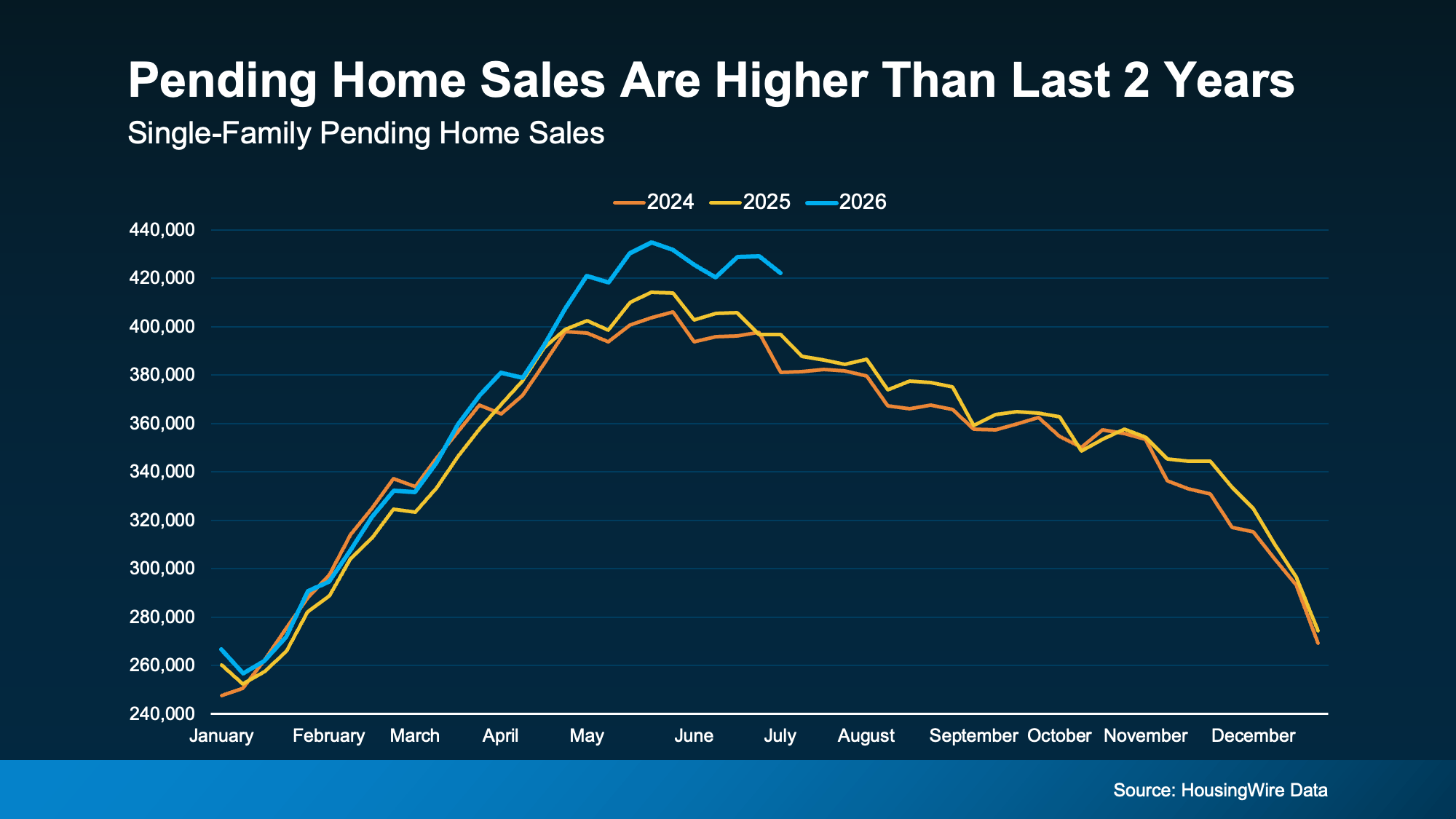
Aunque pueda ser una sorpresa, los números hablan por sí solos. No significa que haya compradores por todas partes, pero sí significa que siguen activos en este momento. Y aunque esto fluctúe un poco en las próximas semanas, ahora mismo seguimos por delante de donde hemos estado últimamente. Son noticias alentadoras si estás pensando en vender, porque nos dicen algo importante…
La gente no ha dejado de comprar casas. Los compradores serios siguen moviéndose en el mercado.
Y muchas de estas personas están comprando porque decidieron que no pueden seguir esperando. Ya sea por una familia en crecimiento, un nuevo trabajo, la jubilación o simplemente por el deseo de tener una casa diferente, la vida sigue avanzando… incluso cuando las tasas hipotecarias se mantienen más altas de lo que nos gustaría. Como explica Lawrence Yun, Economista Jefe de la Asociación Nacional de Agentes Inmobiliarios (NAR, por sus siglas en inglés):
“Una oleada de compradores a finales de la primavera —incluso con las tasas hipotecarias sin moverse— es un indicador de la demanda de vivienda acumulada y de la aceptación por parte de los consumidores de las tasas hipotecarias por encima del 6% como la nueva normalidad”.
Entonces, si te preocupaba que nadie estuviera comprando, estos datos deberían darte cierta confianza. Los compradores de hoy en día no están simplemente paseando de forma casual por jornadas de puertas abiertas un domingo por la tarde; han pasado meses esperando a que las tasas mejoren y ahora se dan cuenta de que ya no pueden esperar más.
Eso significa que tienen un propósito y un plazo establecido. Y ese es exactamente el tipo de comprador motivado con el que quieres trabajar.
Lo que esto significa para tu venta
¿Significa esto que todas las casas se venderán al instante? No.
El mercado actual está más equilibrado de lo que estaba hace unos años. Por lo tanto, no puedes simplemente ponerle a tu casa el precio que quieras o saltarte su preparación para salir al mercado.
Ahora los compradores tienen opciones, y están dispuestos a esperar la casa adecuada al precio adecuado. Pero los vendedores que entienden el mercado actual (y que ponen el precio y posicionan sus casas correctamente) siguen teniendo éxito. Porque la idea de que “nadie está comprando ahora mismo” simplemente no está respaldada por los datos.
Los compradores están ahí.
La oportunidad está ahí.
La clave es tener la estrategia adecuada para capturarla.
En conclusión
El mercado inmobiliario de este año puede que se esté moviendo más lento de lo que muchos de nosotros esperábamos. Pero la demanda de los compradores es más resiliente de lo que sugieren los titulares.
Si te preguntas si hay suficientes compradores para tu casa, hablemos. Te mostraré lo que está sucediendo en nuestro mercado local y diseñaremos una estrategia que te ayude a aprovechar el impulso que ya existe.
Gracias por leer,
Denise Olivares-Molina

by Denise Olivares-Molina | Jul 20, 2026 | Advice for Buyers and Sellers, Advice for Homeowners, Advice for Sellers, Affordability, For Sellers, Home Prices, Home Selling Strategy, Home value, Housing Market, Housing Market Insights, Housing Market Updates, Pricing Strategy, Seller, Sellers, Selling A Home, Selling Myths, Selling Tips, Weekly
If you’ve been thinking about selling, you’ve probably seen plenty of headlines suggesting buyers have just about disappeared. But there’s a big difference between a slow market and a stalled one.
Yes, mortgage rates are still higher than most people would like. Homes aren’t selling as fast as they were. And every week seems to bring another headline about buyers sitting on the sidelines. But here’s what you haven’t heard.
Despite everything going on, buyer demand has been remarkably resilient.
In fact, more sellers are getting to put up the “pending sale” sign now than during the last two years. What’s even more surprising is that they’re doing it at a time of year when activity usually starts to slow down.
And if you’re thinking about selling, that’s a trend worth paying attention to.
Buyers Are More Active Than You Think
One of the best ways to measure buyer demand is by looking at pending home sales. Those are homes that have gone under contract but haven’t closed yet. Think of them as a real-time pulse check on the market and whether buyers are still buying.
HousingWire Data shows more homes are going under contract than at the same time the past 2 years (see graph below):
While it may come as a surprise, the numbers speak for themselves. It doesn’t mean buyers are everywhere, but it does mean they’re still active right now. And even if this ebbs and flows a bit in the weeks ahead, right now we’re still ahead of where we’ve been lately. That’s encouraging news if you’re thinking about selling because it tells us something important…
People haven’t stopped buying homes. Serious buyers are still making moves.
And a lot of these people are buying because they decided they can’t keep waiting. Whether it’s a growing family, a new job, retirement, or simply wanting a different home, life keeps moving… even when mortgage rates stay higher than we’d like. As Lawrence Yun, Chief Economist at the National Association of Realtors (NAR), explains:
“A late spring buyer rush—even with mortgage rates not budging—is an indication of pent-up housing demand and consumers’ acceptance of above-6% mortgage rates as the new normal.”
So, if you’ve been worried no one’s buying, this data should give you some confidence. Today’s buyers aren’t just casually browsing open houses on a Sunday afternoon, they’ve spent months waiting for rates to improve and now they realize they can’t wait anymore.
That means they have a purposeand a timeline. And that’s exactly the kind of motivated buyer you want to work with.
What This Means for Your Sale
Does that mean every house will sell instantly? No.
Today’s market is more balanced than it was a few years ago. So, you can’t just price your house however you want or skip preparing it for the market.
Now buyers have choices, and they’re willing to wait for the right home at the right price. But sellers who understand today’s market (and price and position their homes right) are still finding success. Because the idea that “no one’s buying right now” just isn’t supported by the data.
The buyers are there.
The opportunity is there.
The key is having the right strategy to capture it.
Bottom Line
This year’s housing market may be moving slower than many of us hoped. But, buyer demand is more resilient than the headlines suggest.
If you’re wondering whether there are enough buyers for your house, let’s connect. I’ll show you what’s happening in our local market and build a strategy that helps you take advantage of the momentum that’s already here.
Thank You For Reading
Denise Olivares-Molina
