
by Denise Olivares-Molina | Jul 20, 2026 | Advice for Buyers, Buyers, Buying A Home, Buying Myths, Buying Tips, Economy, Elegant Designs, Housing Market, Housing Market Insights, Housing Market Shifts, Housing Market Updates, Infographic, Market Trends, Market Updates, Real Estate Finances, Real Estate Goals, Real Estate Investing, Real Estate Market, Real Estate Market 2026, Real Estate Trends in 2026, Recipes, Weekly
If you’ve thought about buying a home in the past few years, you may have run into two frustrations: asking prices that kept climbing and too few homes to choose from.
In many places, both sticking points are letting up this summer, with lower asking prices and more homes for sale. Let’s look at the trends, and what they mean for your search.
Sellers Are Pricing To Attract Buyers
According to Realtor.com, the national median asking price was $430,000 in June, nearly $11,000 under what it was the year before (see graph below):
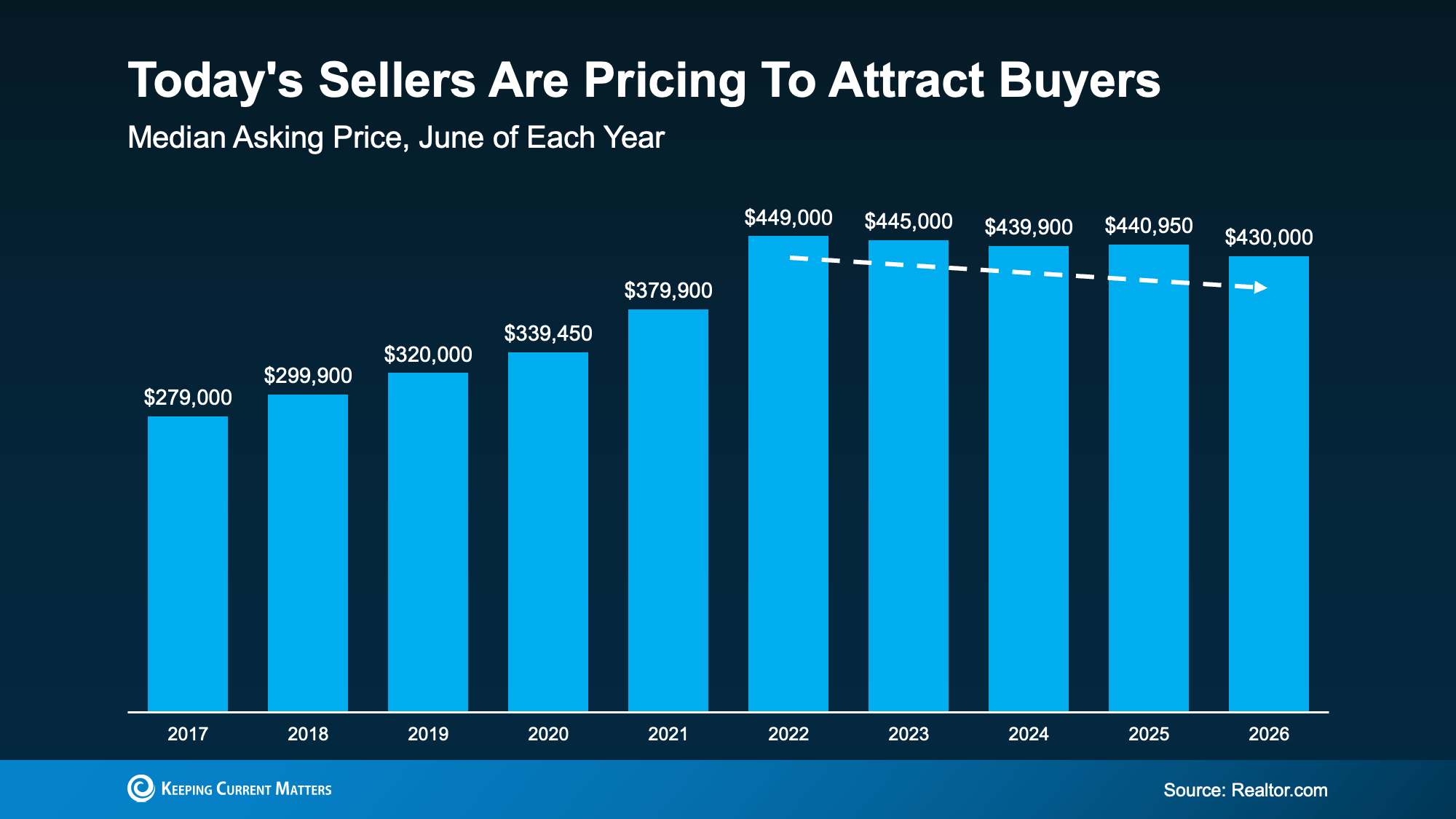
That’s the eighth month in a row that the typical asking price has dipped below where they were the previous year, according to the same Realtor.com report.
And while falling prices can sound worrying, this isn’t a sign of an impending crash. We’re talking about asking prices, not sold prices. This is a sign that today’s sellers are meeting the market where it is and pricing to draw buyers. And that’s actually something normal we’d expect from the market. As Danielle Hale, Chief Economist at Realtor.com, puts it:
“Sellers are reading market conditions and are pricing accordingly from the start rather than listing high and cutting later, and buyers are taking note and making bids. This is a welcome sign that we are in a functioning market.”
Asking prices were never going to climb forever – now they’re just settling closer to what buyers can actually pay. That signals a healthier market, and sellers re-adjusting their expectations.
More Homes Are Available Now
If you’ve spent the past few years watching homes disappear before you could even schedule a tour, this is for you.
Supply is starting to catch up. According to Realtor.com, the number of homes listed for sale in June was the highest June number we’ve seen in three years (see graph below):
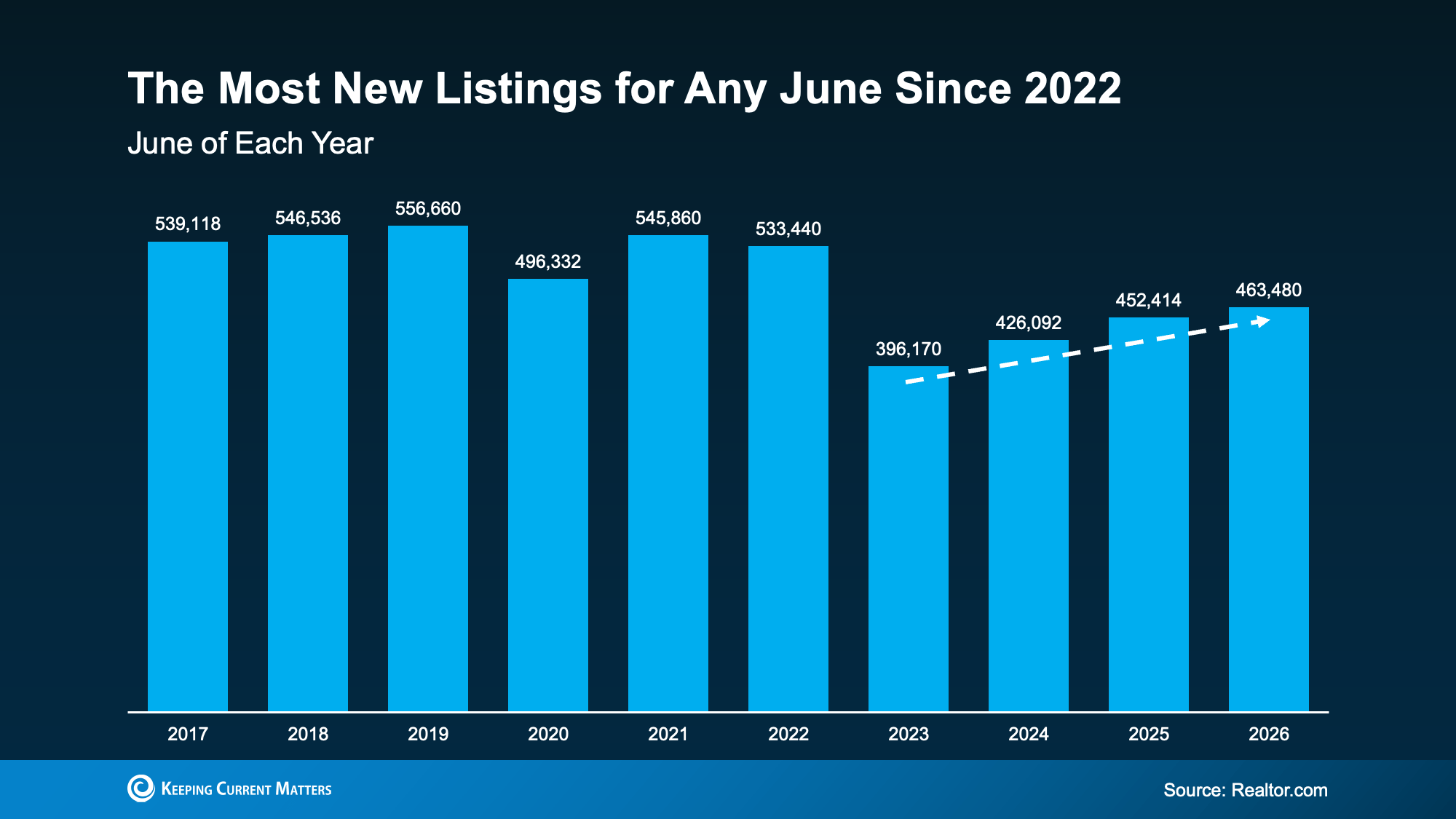
This means more options for you and less competition for each one.
Now, supply is not back to normal everywhere. As you can see, we’re still down from where we were back in 2017-2019. But in many places, it’s better than it’s been in a while. Here’s how that helps you.
You don’t have to rush an offer just to stay in the running, and you have better odds of finding and landing the right home, not just the one that’s available. Plus, you’ll have more room to negotiate, so you’re searching from a stronger position than buyers had even a year ago.
Why This Is Encouraging if You’re Buying Your First Home
For first-time buyers looking for lower-priced homes, these trends line up especially well. Mischa Fisher, Chief Economist at Zillow, explains:
“The lowest price tiers are exhibiting some softness in terms of price, they also had the most listing-activity growth, the first time since 2022 that’s been the case.”
So, if you’re searching for your first place or your next house, there’s a little more to choose from and a little more give on price.
Bottom Line
If a tight budget or a thin selection has kept you from buying a home, now might be the time to restart your search.
Ready to see what’s available here? Let’s connect.
Thank You For Reading,
Denise Olivares-Molina

by Denise Olivares-Molina | Mar 30, 2026 | 2026 Housing Market, 2026 Mortgage Rate, Advice for Buyers, Affordability, Costs, Current Trends, First Time Home Buyers, First-Time Buyers, For Buyers, Home Equity Loans, Home Prices, Home value, Housing Market Shifts, Housing Market Updates, Infographic, Interest Rates, Pricing, Real Estate Finances, Real Estate Market, Real Estate Tips, Real Estate Trends in 2026, Weekly
Mortgage rates have been volatile lately. And if you’re thinking about buying a home, that can make it harder to plan. But there are still things you can do to get the best rate possible in today’s market. It starts with having the right information.
So, what’s causing the bumps in rates? And what can you do about it? Let’s break it down.
Mortgage Rate Volatility Is Normal
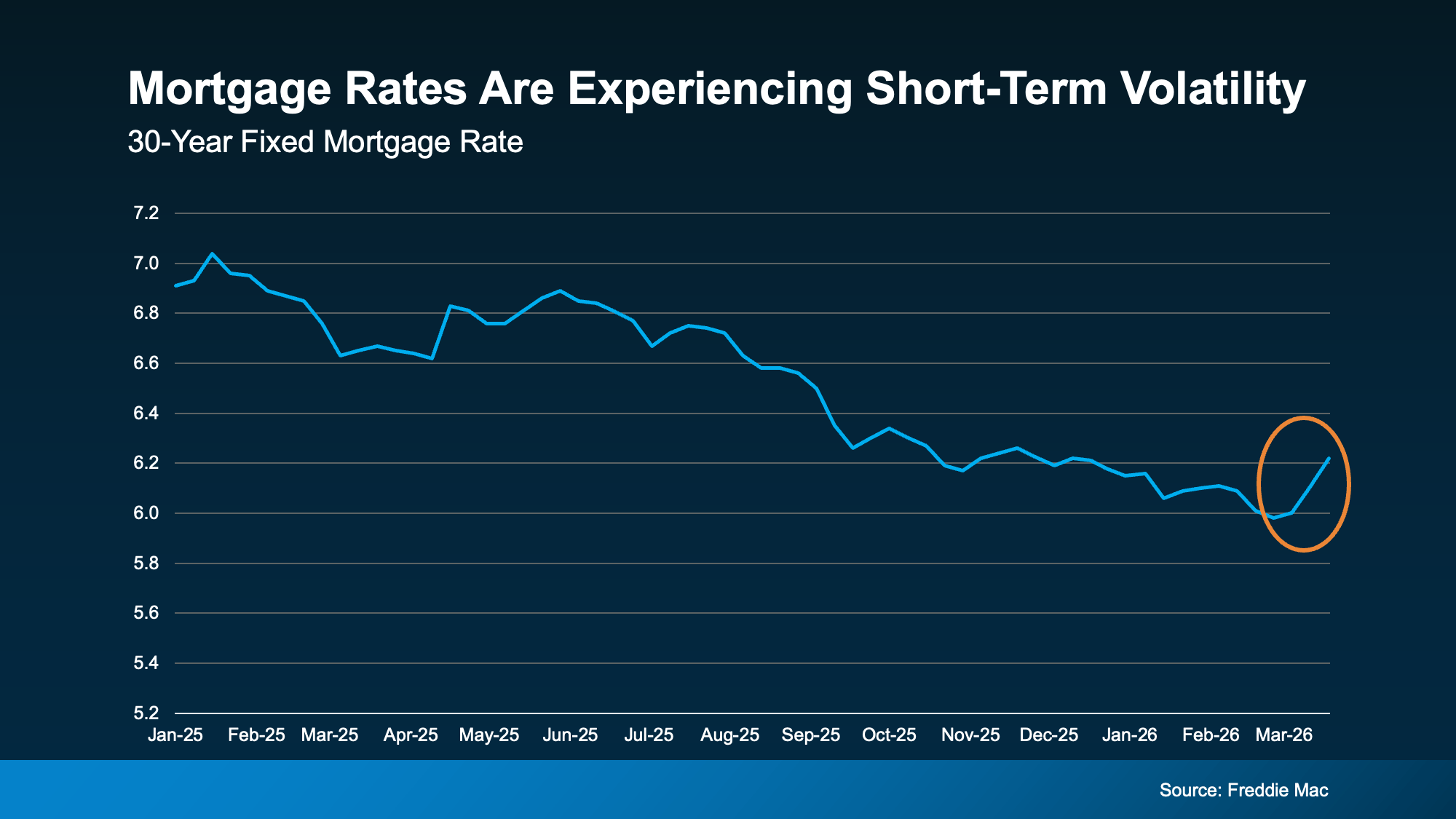
Data from Freddie Mac shows the recent volatility. After trending down for well over a year, there was a rise this month (see graph below):
While it’s easy to be distracted by the changes, here’s what you need to remember.
It’s normal for rates to bounce around a bit here and there. For example, if you look back at the graph, you’ll see that even within the past year there have been times like this when rates inched up. We’re in one of those moments right now and you need to be aware of that.
Especially when there’s economic uncertainty or big global events happening, volatility like this is expected. As Investopedia explains:
“Mortgage rates don’t move in isolation. When global events inject uncertainty into financial markets . . . that can ripple through to borrowing . . . mortgage costs can respond quickly to geopolitical developments. As long as uncertainty remains elevated, rate swings may continue.”
And that’s one of the reasons why trying to time the market isn’t a wise move.
You can’t control what happens with mortgage rates. But there are still things you can do to help you get the best rate possible in today’s market. And here’s where to focus your effort.
Your Credit Score
Your credit score plays a big role in the rate you qualify for. Even a small improvement can make a noticeable difference in your monthly payment. As Bankrate puts it:
“Your credit score is one of the most important factors lenders consider when you apply for a mortgage. Not just to qualify for the loan itself, but for the conditions: Typically, the higher your score, the lower the interest rates and better terms you’ll qualify for.”
So, make sure you do what you can to keep your credit score up. If you’re not sure what your score is or how you can improve it, talk to a trusted loan officer.
Your Loan Type
There are also different types of home loans – and each one can have unique requirements, benefits, and rates for qualified buyers. The Consumer Financial Protection Bureau (CFPB) explains:
“There are several broad categories of mortgage loans, such as conventional, FHA, USDA, and VA loans. Lenders decide which products to offer, and loan types have different eligibility requirements. Rates can be significantly different depending on what loan type you choose.”
That’s why it’s so important to explore your options with a lender. You may even want to talk to multiple lenders to see how the options vary.
Your Loan Term
The length of your loan matters too. Most lenders typically offer 15, 20, or 30-year loans. Freddie Mac offers this advice:
“When choosing the right home loan for you, it’s important to consider the loan term, which is the length of time it will take you to repay your loan before you fully own your home. Your loan term will affect your interest rate, monthly payment, and the total amount of interest you will pay over the life of the loan.”
Again, to figure out what makes the most sense for your budget and long-term goals, have a lender walk you through all your options.
Bottom Line
Thinking about buying right now? The best advice is to accept that you can’t control where rates are going to go from here.
What you can do is work with a trusted lender and take steps that’ll help you get the best rate possible.
So, if you want to move today, let’s make it happen. We just need to control the controllables and focus where it counts.
Thank you for reading
Denise Olivares-Molina

by Denise Olivares-Molina | Jan 26, 2026 | Advice for Buyers, Buyers, Buying A Home, Demographics, Discretionary Buyers, First-Time Buyers, For Buyers, Home Buying, Home Prices, Home value, Homeowner Information, Housing Market Shifts, Housing Market Updates, Infographic, Real Estate Finances, Real Estate Goals, Real Estate Investing, Real Estate Market, Real Estate Tips, Real Estate Trends in 2026, Weekly
When you see a house that’s been sitting on the market for a while, the reaction is almost automatic. You start thinking:
That mindset made sense a few years ago. But in today’s market, you may actually miss out.
More Time on Market Isn’t Automatically a Concern Anymore
A few years ago, homes sold in just a matter of days. Sometimes, hours. Anything that lingered longer than that raised concerns. But that’s no longer the baseline.
Inventory has grown. Buyers have more choices. And homes are taking longer to sell across the board. Those are some of the reasons why the typical time it takes a home to sell has climbed this year:
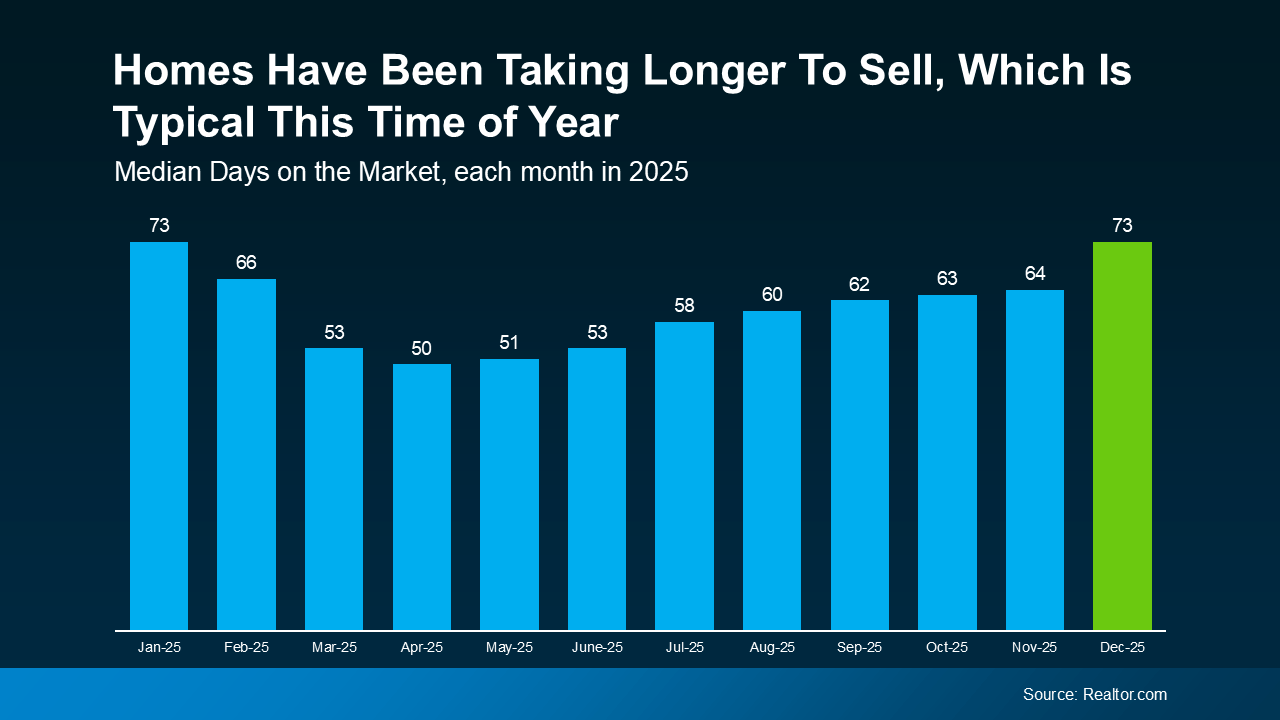 And it’s not that 73 days is slow. That’s actually pretty normal for this time of year. It just feels slow because you heard so much about houses being snapped up in the buying frenzy a few years ago.
That shift alone explains a lot of what you’re seeing. It’s not necessarily that there’s anything wrong with the house itself. Although, let’s be honest, sometimes that is the case.
Most of the time today, a house that’s taking longer to sell simply means:
-
There are a lot of homes for sale in that area
-
The seller priced a little too high at first
-
The home didn’t photograph as well online
-
Buyers passed it over for flashier listings nearby
-
The timing just wasn’t right when it first hit the market
None of those are necessarily deal-breakers.
What Buyers Often Get Wrong About These Listings
Because even though you may assume a house that hasn’t sold must have hidden issues, the reality is, that’s not always the case. And, if the house does have issues, it’ll show up quickly in your inspection.
That’s information you can use to negotiate. Not a reason to walk away automatically. And in many cases, that’s where buyers find the best deals.
The key is knowing which homes that have been sitting for a while are worth a second look – and which ones aren’t. That’s why working with a local agent makes a real difference. They’ll be able to look at disclosures and more to help you uncover hidden gems other buyers may overlook.
Bottom Line
A home sitting on the market isn’t always a warning sign. Sometimes it’s an overlooked opportunity.
If you want help identifying which homes are worth a second look (and which ones to skip), let’s talk.
Thank You For Reading
Denise Olivares-Molina

by Denise Olivares-Molina | Oct 20, 2025 | Advice for Buyers and Sellers, Advice for Homeowners, Advice for Sellers, For Sellers, Home Prices, Home value, Homeowner Information, Housing Market, Housing Market Shifts, Housing Market Updates, Infographic, Pricing, Real Estate 2025, Real Estate Finances, Real Estate Goals, Real Estate Investing, Real Estate Market, Real Estate Tips, Weekly
Si ha visto titulares o publicaciones en redes sociales que anuncian un colapso inmobiliario, es fácil preguntarse si el valor de las viviendas está a punto de caer. Pero esta es la simple verdad.
Los datos no apuntan a un colapso. Apuntan a un crecimiento lento y continuo.
Y claro, esto variará según la zona. Algunos mercados verán subir los precios más que otros. Y algunos incluso podrían ver pequeñas caídas a corto plazo. Pero el panorama general es que se espera que los precios de las viviendas suban a nivel nacional, no que bajen, en los próximos 5 años.
La verdadera historia está en los pronósticos de los expertos
En la Encuesta de Expectativas de Precios de la Vivienda (HPES, por sus siglas en inglés) de Fannie Mae, más de 100 de los principales expertos del mercado inmobiliario opinan cada trimestre sobre hacia dónde proyectan que irán los precios de la vivienda a partir de ahora. Y en el informe que se acaba de publicar, los expertos coinciden en que se prevé que los precios suban a nivel nacional al menos hasta 2029 (ver el gráfico a continuación):
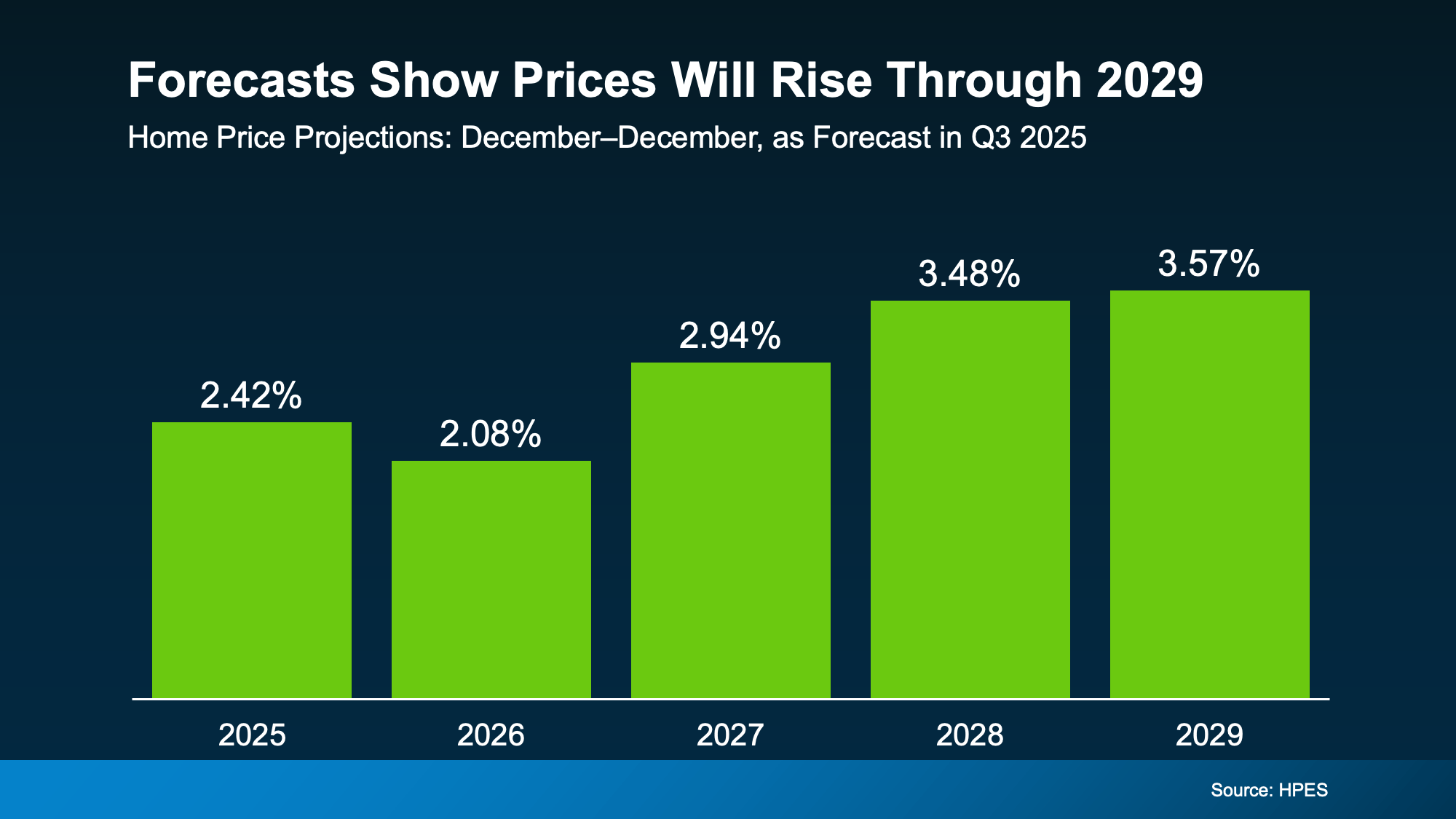
Así es como se interpreta este gráfico. Cada barra muestra un aumento, no una pérdida. Lo que ocurre es que el ritmo previsto de esa apreciación varía de un año a otro.
Y para recalcar esto aún más, veamos otra perspectiva de dónde están los precios y hacia dónde se espera que vayan. En esta versión, los pronósticos de los expertos se dividen en 3 categorías: el promedio general, las proyecciones más optimistas y las más pesimistas (ver la tabla a continuación):
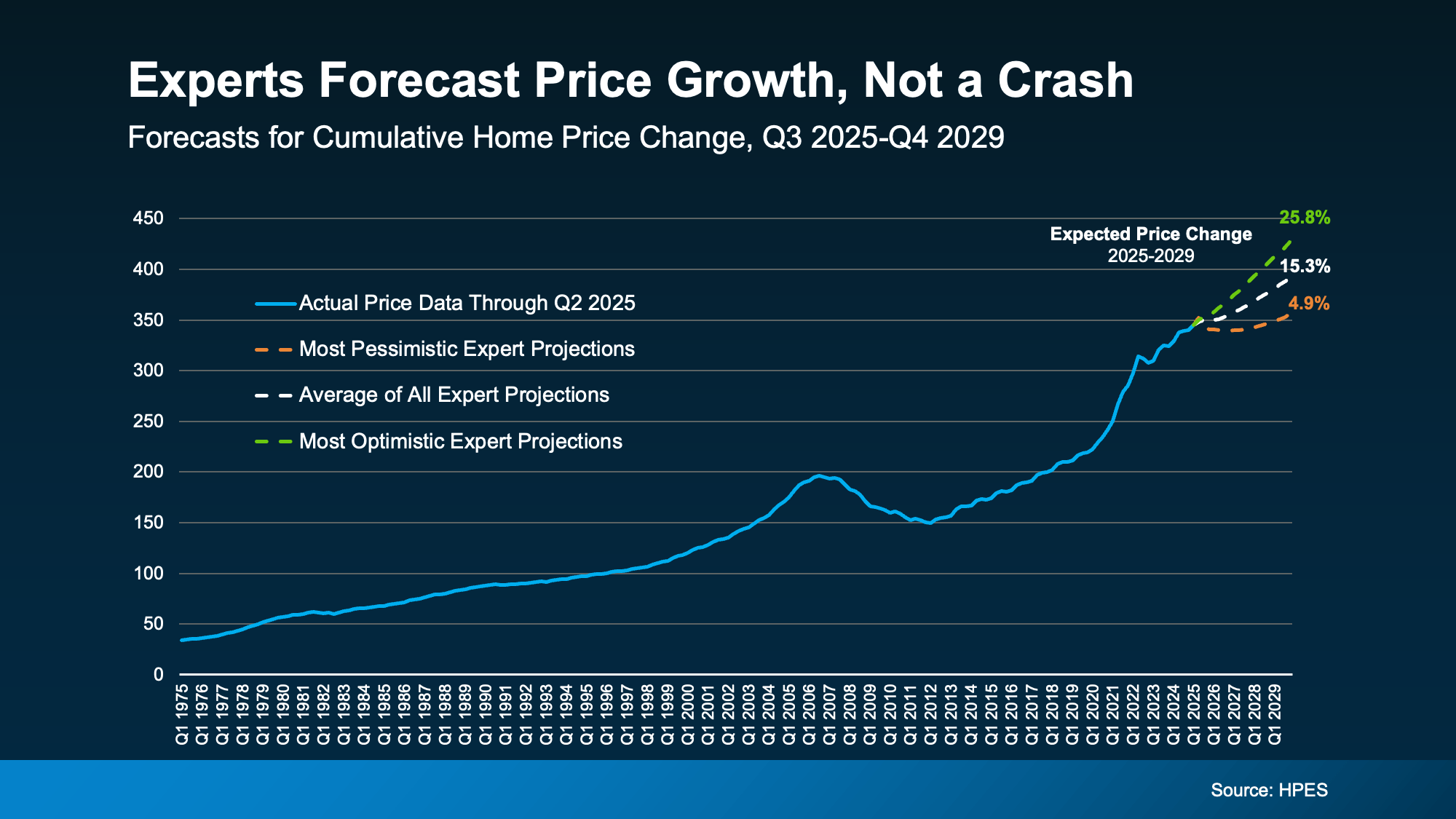
Observe cómo incluso los pronosticadores más pesimistas dicen que veremos un aumento de precios de casi el 5% en los próximos años.
- En general, se espera que los precios suban alrededor de un 15% desde ahora hasta finales de 2029.
- Los optimistas dicen que superaremos esa cifra y veremos un aumento de aproximadamente el 26%.
- E incluso los pesimistas anticipan que los precios subirán un 5% durante ese período.
¿Qué es lo que más destaca? Ninguno de estos grupos que estudian el mercado pronostica un colapso, ni siquiera una caída, en los próximos 5 años.
Cómo se compara esto con lo “normal” para el mercado
Ahora, volvamos al primer gráfico. Las proyecciones indican aumentos de precios del 2 al 3.5% en cada uno de los próximos cinco años. Para ponerlo en contexto, la tasa de apreciación promedio de los últimos 25 años fue más cercana al 4-5% anual.
Entonces, aunque eso está ligeramente por debajo del promedio histórico, es mucho más sostenible y típico que la situación del mercado en 2020, 2021 y 2022.
En aquel entonces, los precios subieron demasiado y muy rápido debido a una oferta históricamente baja y una demanda históricamente alta. En algunos lugares, los precios llegaron a subir entre un 15% y un 20%.
Por lo tanto, aunque pueda parecer que los precios se están estancando en comparación con las subidas de la era de la pandemia, lo que realmente está sucediendo es que el mercado finalmente está encontrando el equilibrio de nuevo.
Por qué no se espera que los precios colapsen
Gran parte de lo que se dice hoy sobre los precios de la vivienda se basa en esa rápida subida y en el viejo dicho de que todo lo que sube, tiene que bajar. Pero históricamente, eso no es del todo cierto. Los precios de la vivienda casi siempre suben. Y la razón principal por la que no nos dirigimos a una repetición de 2008 es simple: la oferta y la demanda.
Aunque los desafíos de asequibilidad han dificultado la compra para algunas personas en los últimos años, todavía no hay suficientes viviendas para todos los que quieren una. Y esa escasez continua mantiene la presión al alza sobre los precios a nivel nacional.
Por eso los expertos de todos los ámbitos pueden coincidir con confianza: no nos dirigimos a un colapso de precios, sino a una apreciación constante y a largo plazo.
Y por si es la economía lo que le preocupa, recuerde esto.En los últimos 50 años, ha habido muchos acontecimientos económicos que han afectado al mercado. Y algo que ha sido una constante a lo largo del tiempo es que el mercado inmobiliario siempre se recupera. Y ahora mismo estamos superando ese punto de inflexión y entrando en una recuperación.
En conclusión
Si ha estado esperando para comprar o vender porque le preocupa un colapso, es hora de mirar los datos, no los titulares.
La pregunta no es si los precios de la vivienda subirán, sino cuánto.
Pongámonos en contacto para que sepa lo que está sucediendo en nuestro mercado local y lo que estos pronósticos significan para su próximo paso.
Gracias por leer
Denise Olivares-Molina
