
by Denise Olivares-Molina | Sep 1, 2026 | 2026 Housing Market, 2026 Mortgage Rate, Advice for Sellers, Affordability, For Sellers, Forecasts, Homeowner Information, Housing Market, Housing Market Insights, Housing Market Shifts, Housing Market Updates, Mortgage Rates, Protect Your Investment, Real Estate Finances
A recent survey from Talker Research asked Americans to pick one word to describe how 2026 has felt so far. The winner? Stressful. And honestly, there’s been a lot going on.
So, it’s understandable if you’ve been putting off buying or selling a home until things settle down. But you may be waiting on something that’s already happened. While everything else has felt shaky, the housing market has become one of the steadiest things out there. Look at the data.
Home Prices Have Leveled Out
After years of fast increases, data from the National Association of Realtors (NAR) shows home prices have been remarkably steady for the past 4 years (see graph below):
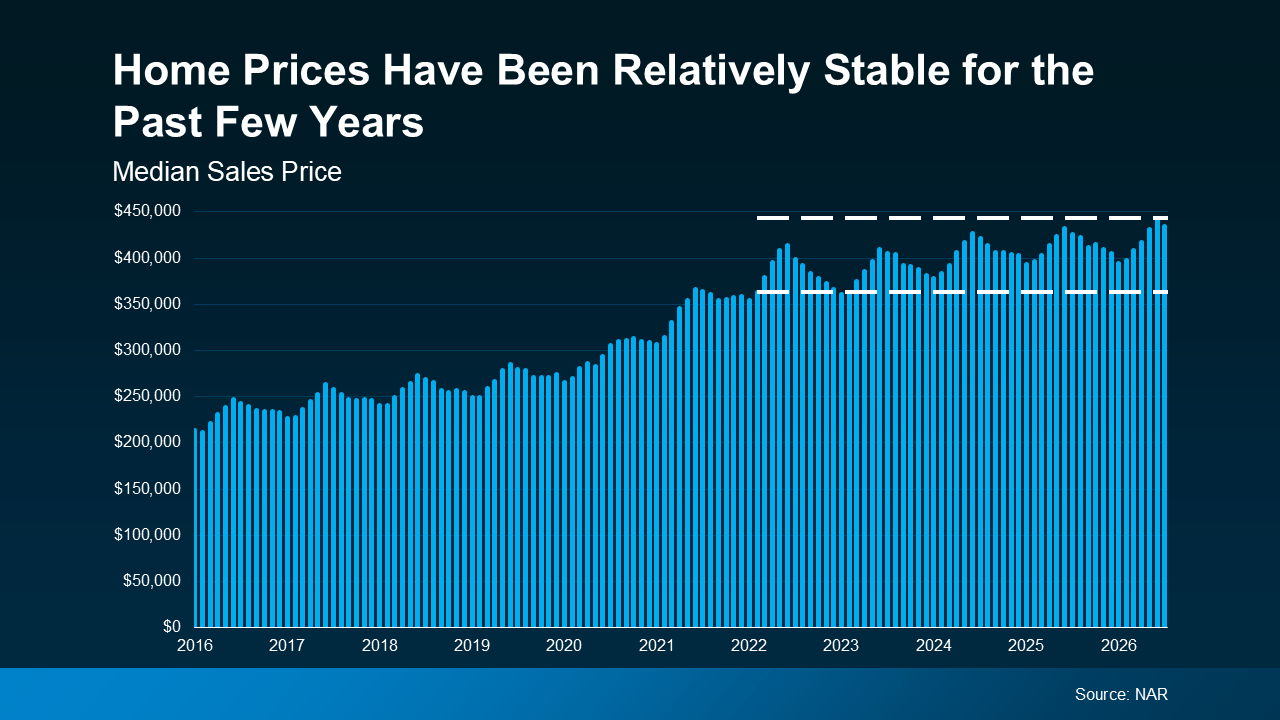 And experts say that’s what to expect going forward, too. As Selma Hepp, Chief Economist at Cotality, explains:
“In 2026, we expect home prices to remain broadly stable, with modest appreciation at a national level.”
No wild swings. Just slow, steady growth. That’s a healthy market. Of course, that pace can vary a bit depending on where you live. But nationally, steady growth like this makes it easier to plan your budget, whether you’re buying or selling.
The Supply of Homes for Sale Has Steadied
For years, the supply of homes for sale was a moving target. It dropped fast during the pandemic and has been climbing pretty reliably ever since. Now, that pace of growth has slowed down. According to Realtor.com, inventory today is very close to where it was this time last year (see graph below):
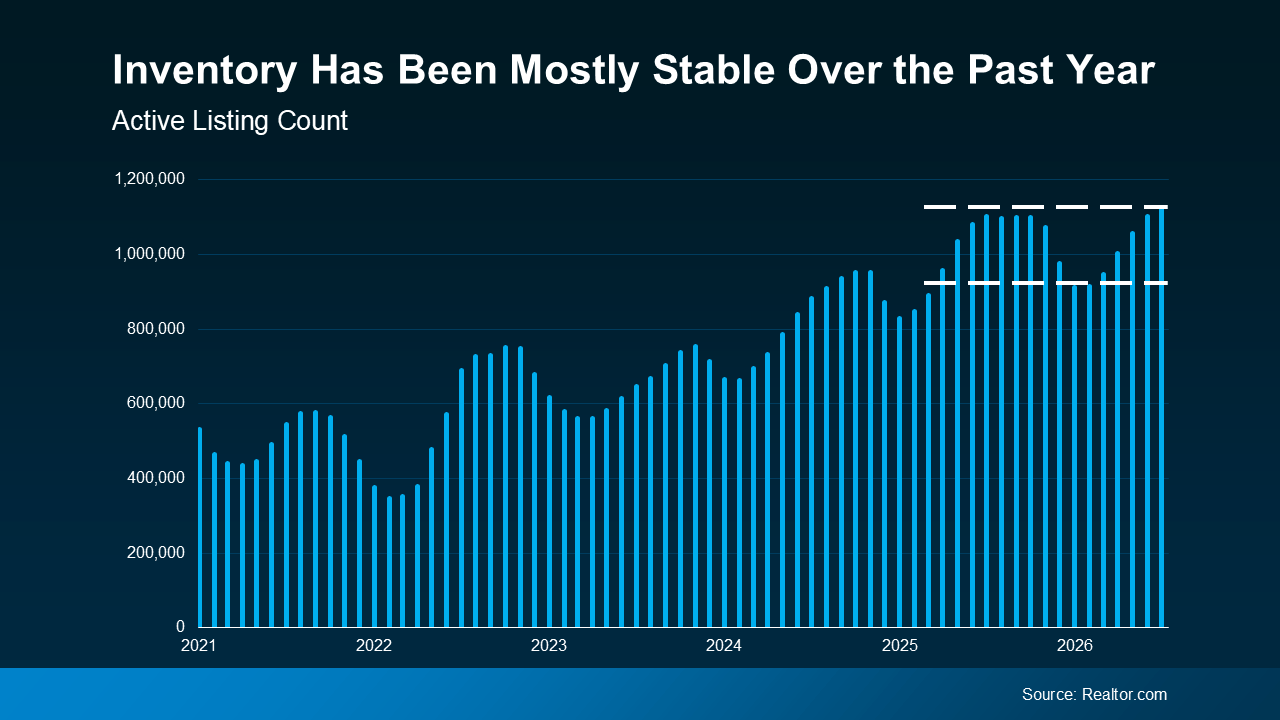 That’s helpful no matter which side you’re on. When the number of homes for sale isn’t changing much, you know what you’re walking into – how many options you’ll have as a buyer, and how much competition you’ll face as a seller.
Mortgage Rates Found Their Range
Yes, rates jumped dramatically back in 2022. But since then, Freddie Mac data shows they’ve stayed between 6% and 7% for the better part of the last 3 or so years (see graph below):
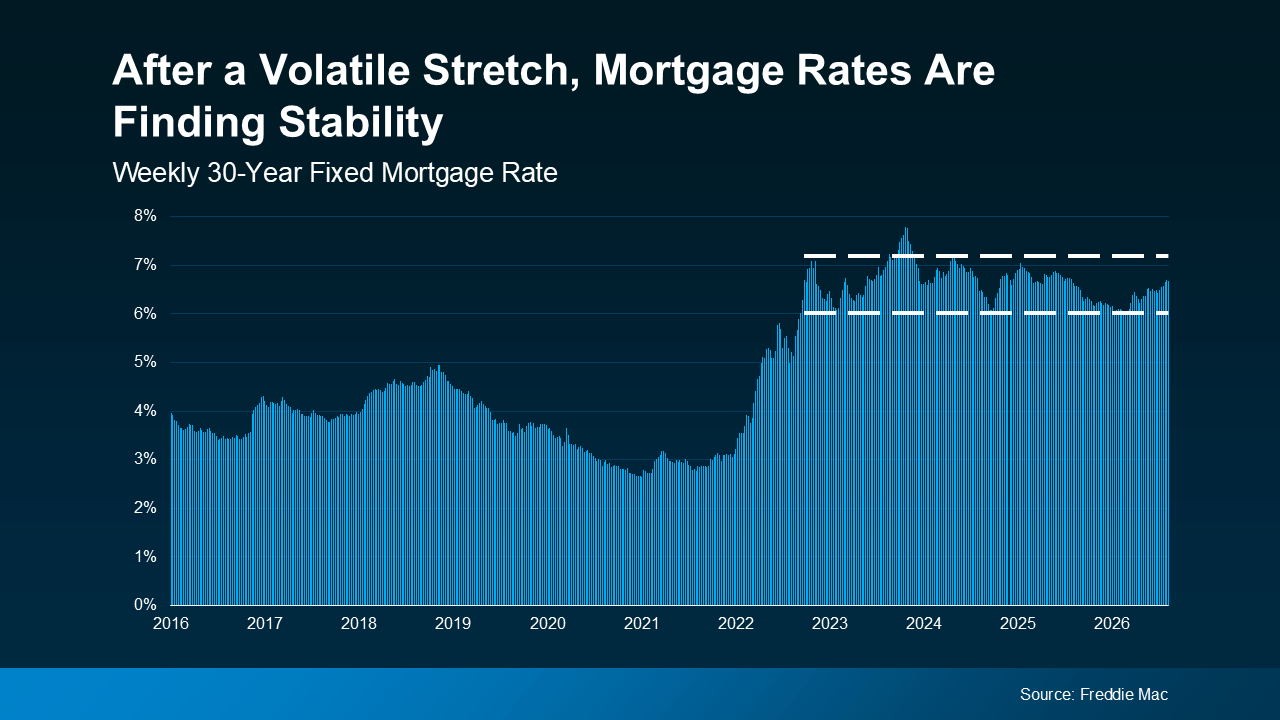 Yes, there was one brief spike above that threshold, but overall, rates have stayed in that range for a while now. That predictability helps when you’re planning a move.
And now that this seems to be a longer-term trend, people have accepted it as the new normal. Buyers have gotten comfortable purchasing in that range, and sellers have gotten just as comfortable listing in it.
That comfort’s important because when both sides know what to expect, they keep making moves. In other words, the market isn’t frozen waiting for something to change. It’s moving calmly.
Bottom Line
The rest of the world may feel unpredictable right now, but the housing market doesn’t have to. Prices, inventory, and rates have all found solid ground.
If stability is what you’ve been waiting for, it’s already here. Let’s connect if you want to talk through what that means for your move.
Thank You For Reading
Denise Olivares-Molina

by Denise Olivares-Molina | Sep 1, 2026 | 2026 Housing Market, Advice for Buyers, Agent Value, Buyer Tips, Buyers, Buying A Home, Buying Myths, Buying Tips, First-Time Buyers, First-Time Investors, For Buyers, Home Prices, Housing Market, Housing Market Insights, Housing Market Shifts, Housing Market Updates, Real Estate Finances, Real Estate Market, Real Estate Market 2026, Real Estate Myths, Real Estate Tips, Weekly
Lately, headlines have floated an eye-catching idea about tapping into your 401(k) to cover a down payment on a home. Maybe you’ve caught the buzz and wondered whether that money could get you into a home faster, especially with affordability as tough as it is.
Here’s what you need to remember. Pulling from your retirement savings is a big decision, so take time to weigh all your options first and be sure to talk with a financial expert before you do anything.
Why Dipping into a 401(k) Can Be Tempting
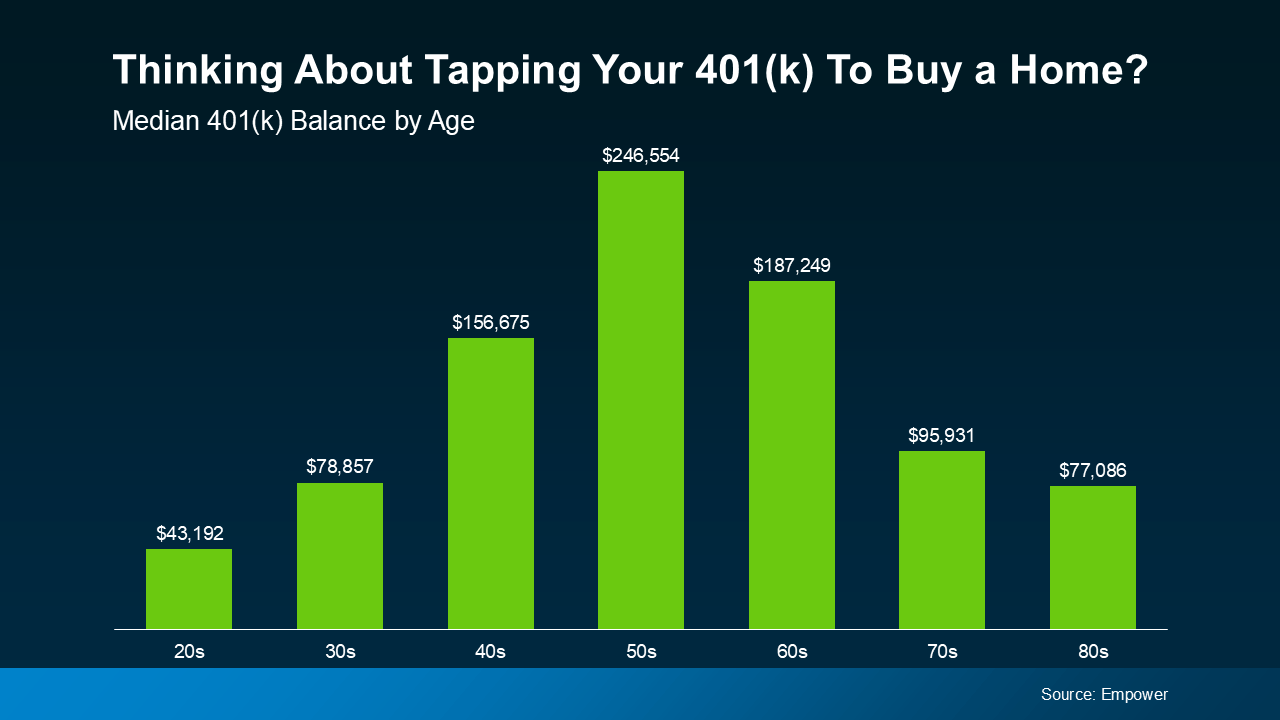
Data from Empower shows many Americans have built up considerable retirement savings. The median 401(k) amount for anyone in their 40s-60s is six figures (see graph below):
 And when you’ve got a good chunk saved and your dream home is right there, reaching for it can feel like an easy call.
But dipping into your retirement savings to buy a home could cost you a penalty and set back your finances later on. That’s why it’s a good idea to explore other options for your down payment first. As Redfin says:
“If you’re struggling to save enough for a down payment, you may be wondering if tapping into your 401(k) is the right option. While it’s possible, doing so comes with significant risks, like early withdrawal penalties and lost investment growth.“
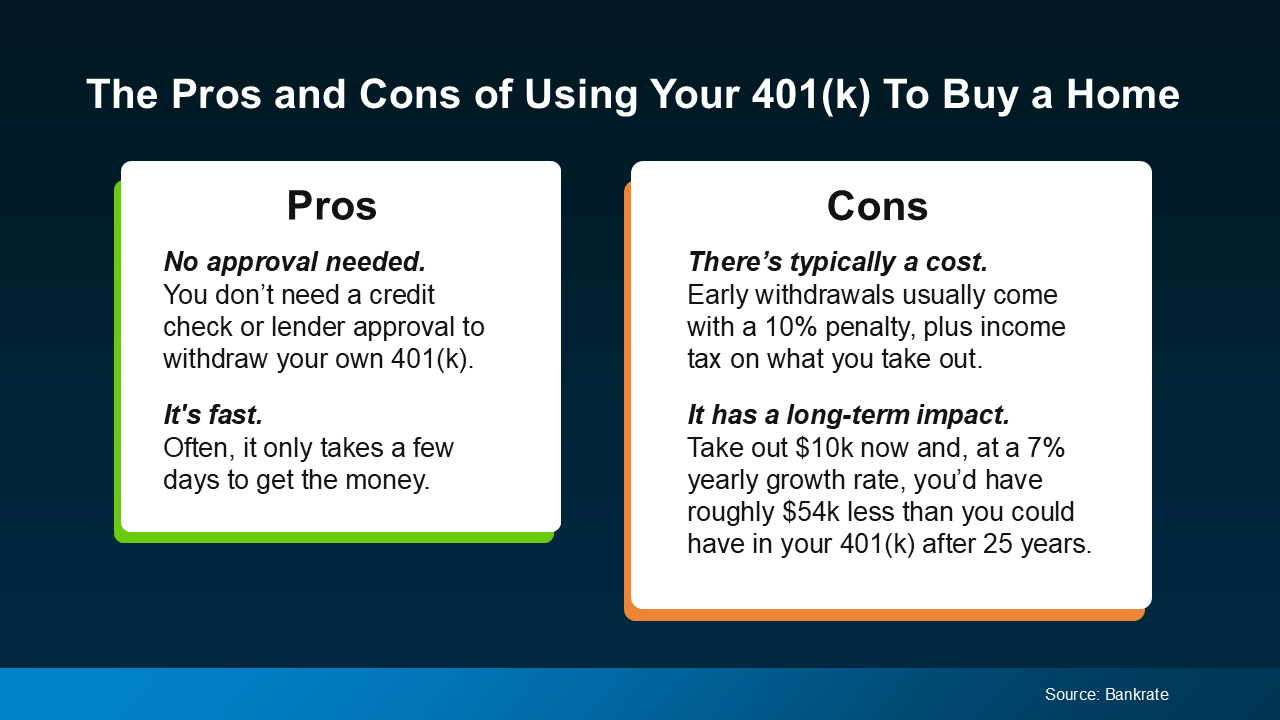
Before you decide, have a financial advisor help you compare the upsides to the risks. Bankrate points to a few of each (see visual):
Other Options Worth Exploring First
Your 401(k) isn’t the only way to finance a home purchase. Redfin outlines a few other options to look into before you decide what to do:
-
Low and No-Down Payment Loans: FHA loans, for example, allow qualified buyers to put down as little as 3.5% of the home’s price, depending on their credit scores.
-
Down Payment Assistance Programs: Many national and local programs can help reduce what you pay toward your down payment or closing costs.
Make a Plan Before You Make a Move
No matter which route you take, talk with a financial expert first. The buyers who come out ahead build a solid plan with the right professionals before starting their journey to homeownership. As NerdWallet puts it:
“Even if you’re convinced a 401(k) loan is the way to go, it’s important to understand the risks at the outset.“
Bottom Line
Affordability is definitely a challenge, but that doesn’t mean tapping your 401(k) is your only way in if you want to buy.
If you’re considering using your 401(k) savings for a down payment, weigh all your options and talk with a trusted financial advisor before you make any decisions. They’ll help you make a plan to fit your goals and your budget.
Thank You For Reading
Denise Olivares-Molina

by Denise Olivares-Molina | Jul 6, 2026 | 2026 Housing Market, Advice for Sellers, Buying A Home, Buying Myths, Buying Tips, Weekly
Comprar o vender una casa es una gran decisión financiera. Y en este momento, se siente aún más grande. La inflación es alta, los costos son altos y quieres tener la seguridad de que es el momento adecuado antes de dar el paso.
Pero si decides animarte, ya sea que estés comprando o vendiendo, aquí hay algo tranquilizador a lo que aferrarse. Tu mudanza no solo cambia tu propia vida, sino que también le da un impulso a toda tu comunidad.
El sector inmobiliario es una parte fundamental de la economía. En 2025, sumó alrededor de $5.6 billones de dólares, según la Asociación Nacional de Agentes Inmobiliarios (NAR, por sus siglas en inglés). Una buena parte de eso proviene de personas comunes y corrientes que compran y venden casas, al igual que tú.
Tu mudanza inyecta dinero real en la economía local
Cada venta hace que el dinero fluya por tu área. Los datos de la NAR muestran que comprar una casa existente (una en la que ya se ha vivido) agrega alrededor de $64,000 a la economía local. Si compras una casa recién construida, ese número asciende a más de $134,000 (ver gráfico a continuación):
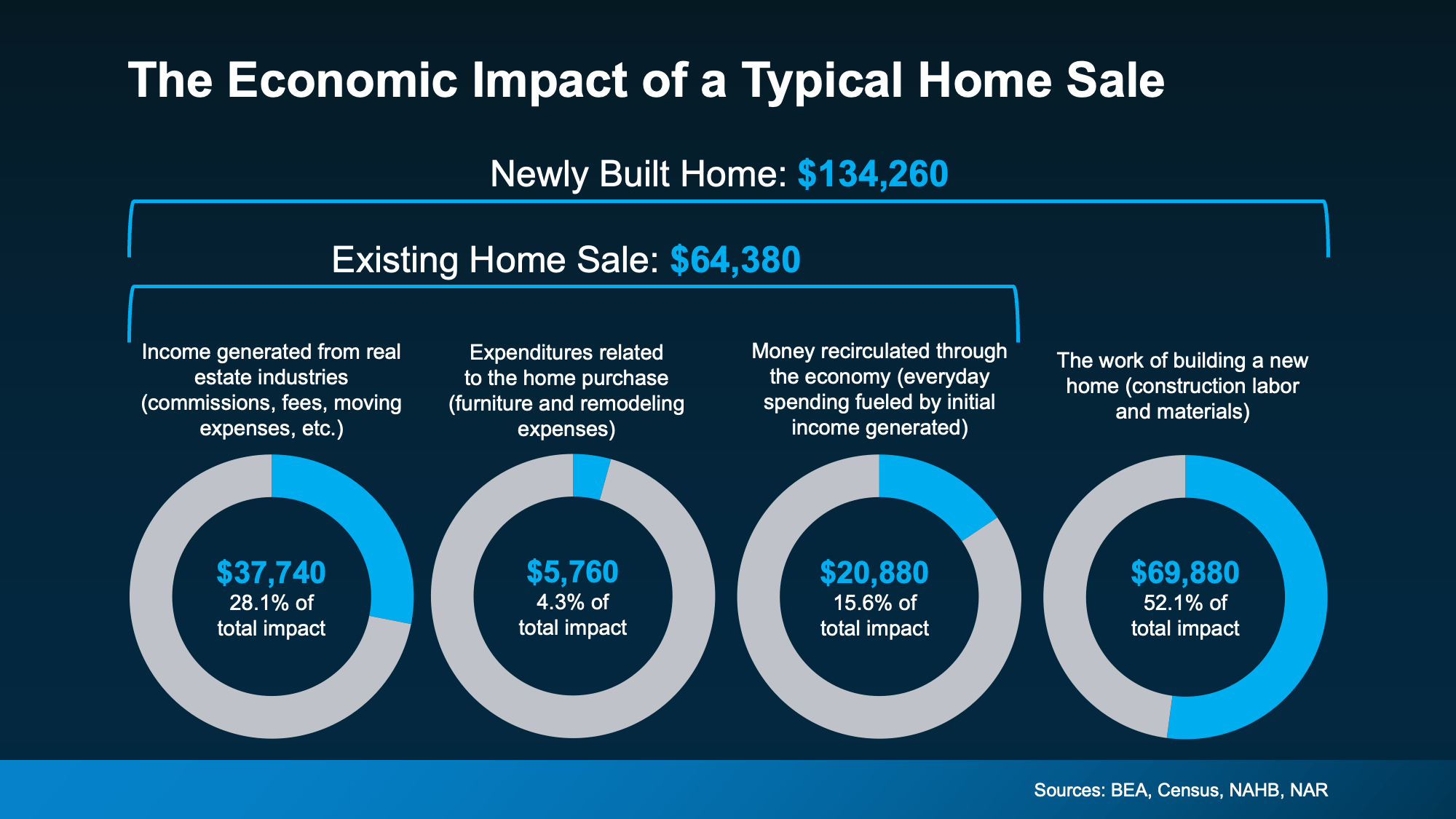
Más de la mitad de esa cifra proviene del trabajo de construcción de la casa en sí. El resto fluye hacia los servicios inmobiliarios, como los honorarios de agentes y prestamistas, además de lo que gastas al instalarte después, en cosas como muebles y remodelaciones.
Y el dinero no se detiene ahí. A medida que los negocios locales lo ganan, lo vuelven a gastar en tu área, por lo que una sola venta tiene un efecto multiplicador que va mucho más allá del precio de venta por sí solo.
Una venta mantiene a mucha gente trabajando
Detrás de cada venta hay toda una red de personas haciendo su trabajo. Contratistas, prestamistas, inspectores, empresas de mudanzas y más. Cuando compras o vendes, ayudas a mantenerlos ocupados. Lawrence Yun, Economista Jefe de la NAR, lo expresa de esta manera:
“El aumento en las ventas de viviendas significa más actividad económica: el cuidado del césped, la compra de muebles, los servicios de mudanzas, la originación de hipotecas y otras actividades comerciales relacionadas reciben un impulso”.
Por lo tanto, tu mudanza también apoya el sustento de tus vecinos. El trato que te lleva a tu próxima casa también ayuda a que un equipo local pueda pagar sus nóminas. En un año en el que cada cheque cuenta, eso no es poca cosa.
Tu impacto local puede ser aún mayor
Lo que tu mudanza aporta financieramente a tu comunidad depende mucho de dónde vivas. Para ayudarte a ver cómo puede variar, aquí tienes un vistazo al impacto de la venta típica de una casa recién construida por estado.
El promedio nacional para una casa recién construida es de aproximadamente $134,000, pero algunos estados ven mucho más (ver mapa a continuación):
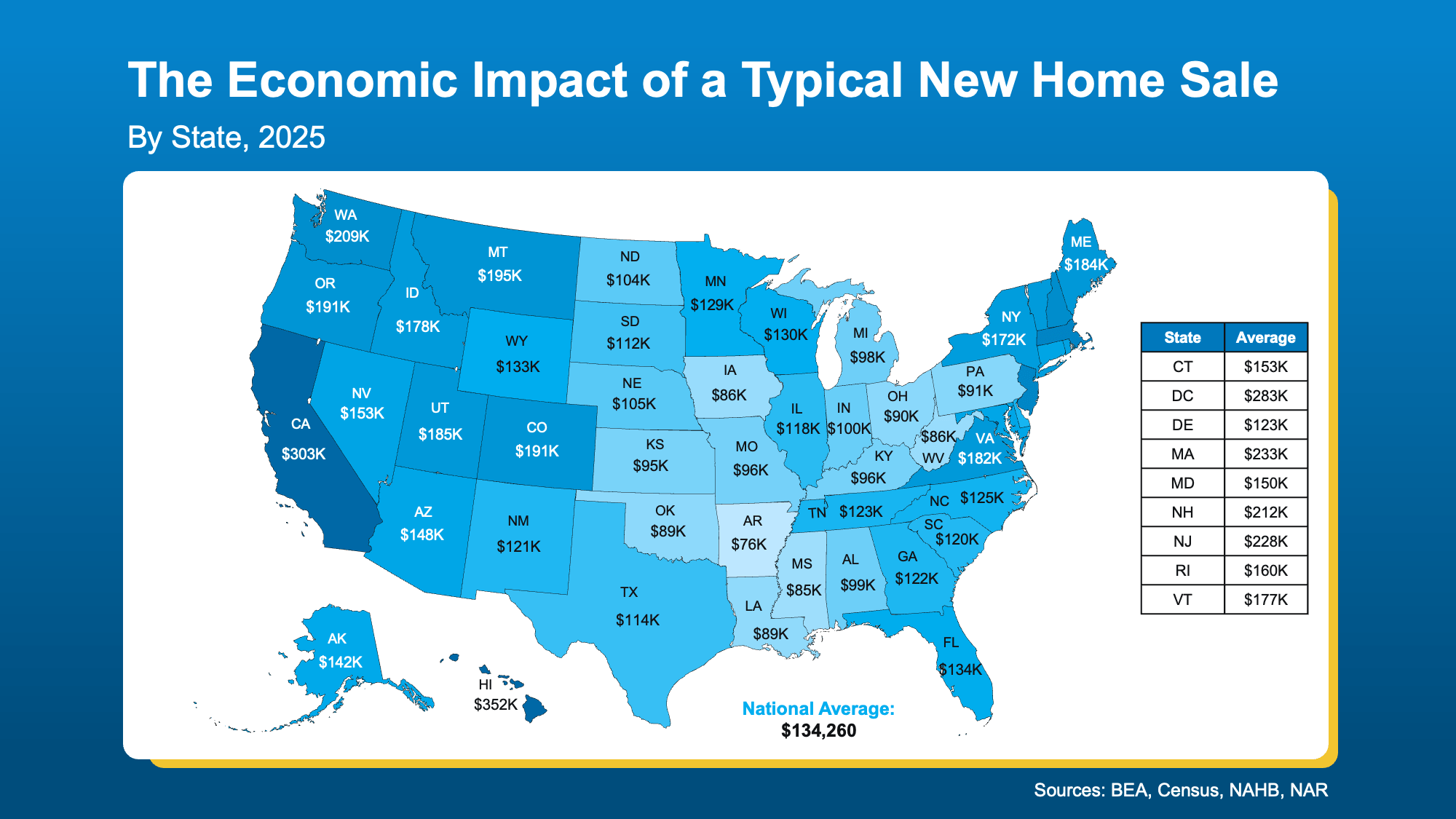
En California, una sola venta agrega más de $300,000 a la economía local. En Hawái, supera los $350,000. Incluso en los estados más asequibles, la cifra llega a las decenas de miles.
¿Quieres saber qué significaría una mudanza en donde vives? Un agente local puede mostrarte la cifra de tu área.
En conclusión
Mudarse es tanto un hito personal como una inversión en tu comunidad. Así que, si es el momento adecuado para ti, pongámonos en contacto. Harás la diferencia para más personas de las que imaginas.
Gracias Por Leer
Denise Olivares-Molina

by Denise Olivares-Molina | Jun 15, 2026 | 2026 Housing Market, Advice for Buyers, Buyers, Buying A Home, Buying Myths, Buying Tips, Housing Market, Weekly
A lot of people who want to move are telling themselves the same thing: “Maybe I’ll just wait until later this year once things calm down.”
While waiting sounds like a good plan, there’s something worth knowing before you decide. Rates aren’t expected to change much, so if that’s the #1 reason you’re waiting, it may not pay off. And there may be other things you miss out on in the meantime.
Historically, Summer is one of the strongest seasons of the year for both buyers and sellers. And if you delay your move until Fall or Winter, some of those opportunities may already be fading.
Buyers: Fresh Inventory Is Your Real Summer Advantage
One of the biggest frustrations buyers have faced over the past few years has been a lack of affordable options. Maybe you’ve run into that yourself:
-
You find a house you like, but it’s out of your budget.
-
You find something in your budget, but you don’t like it.
-
Or worse, nothing interesting hits the market for weeks.
Historically, Summer helps with that.
Looking at data from the last few years, Summer months consistently bring more sellers into the market than later in the year. And that gives buyers a real window of fresh choices.
According to Realtor.com, any given Summer month typically sees about 32% more fresh options than the average month from September-December.
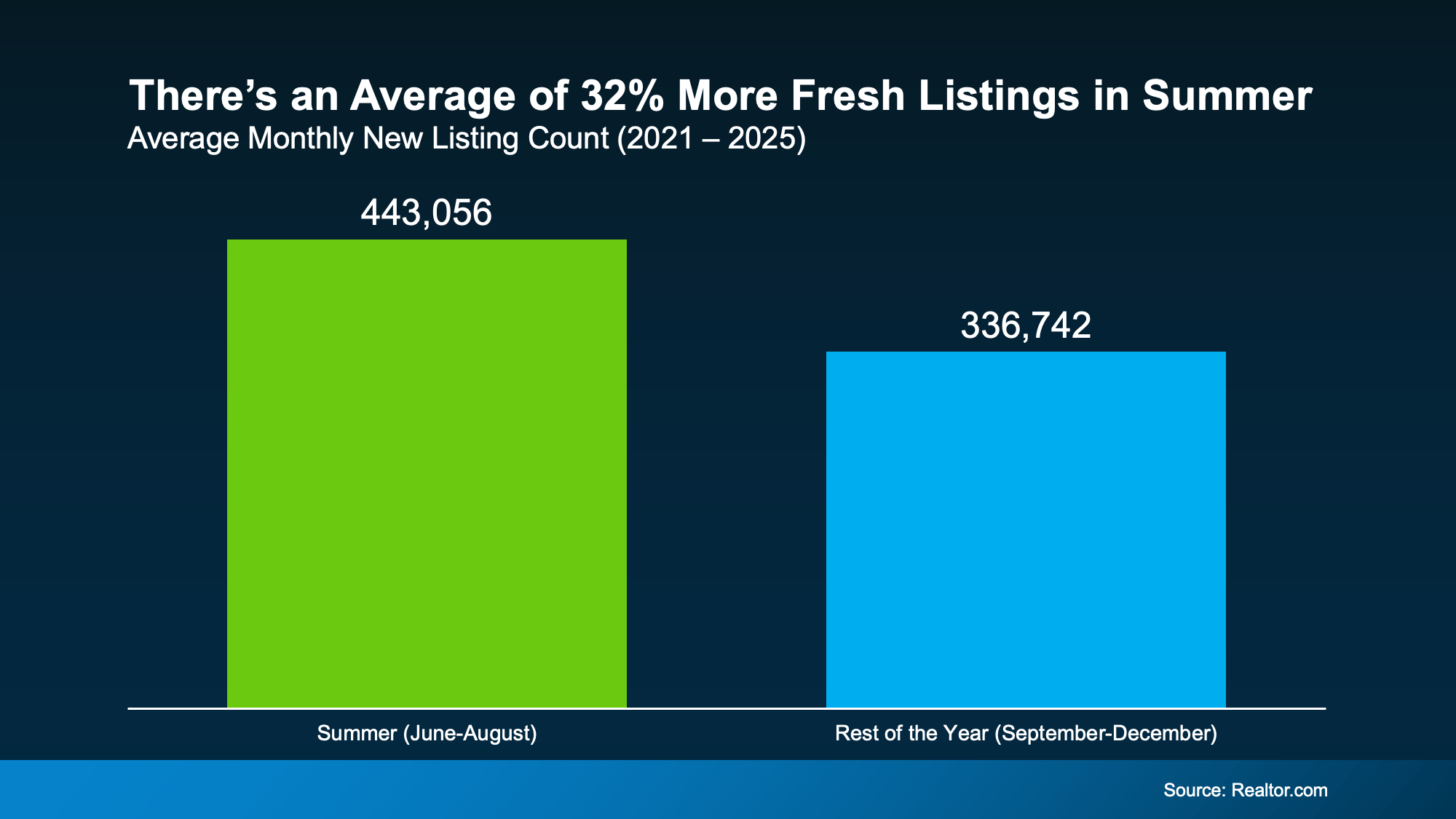
With more newly listed homes, there’s a better chance of finding one you like where the numbers actually work.
Because all it really takes is one home to completely change your search. And if you’ve got more popping onto the market to choose from, maybe one of those is exactly what you need.
But keep in mind, this seasonal window isn’t open forever. Fresh inventory tends to slow down once Summer ends.
Many homeowners who planned to sell this year have already listed by then. Families who wanted to move before school starts have often already gotten it done, or at least, set it into motion. So, new listing activity usually cools as we head into Fall and Winter.
Of course, every year is different. But if finding the right home at the right price has been your biggest challenge, waiting until later in the year may not necessarily give you more options. In fact, recent history suggests it may do just the opposite.
Sellers: Homes Usually Sell for More in the Summer
If you’re thinking of selling, you may be considering holding off because you’ve seen headlines about lower asking prices, price cuts, and softer conditions in some markets. But those headlines don’t tell the whole story or convey just how much it varies by area.
Here’s what you really need to know. Even though the market’s becoming more balanced and some pockets are experiencing price declines, that doesn’t mean you’ve missed your chance to sell.
Seasonality can still work in your favor no matter where you are. And this Summer could still give you the chance to sell for a good price.
According to the National Association of Realtors (NAR), homes sold during a Summer month usually sell for about 4% more than homes sold during the typical month from September-December:
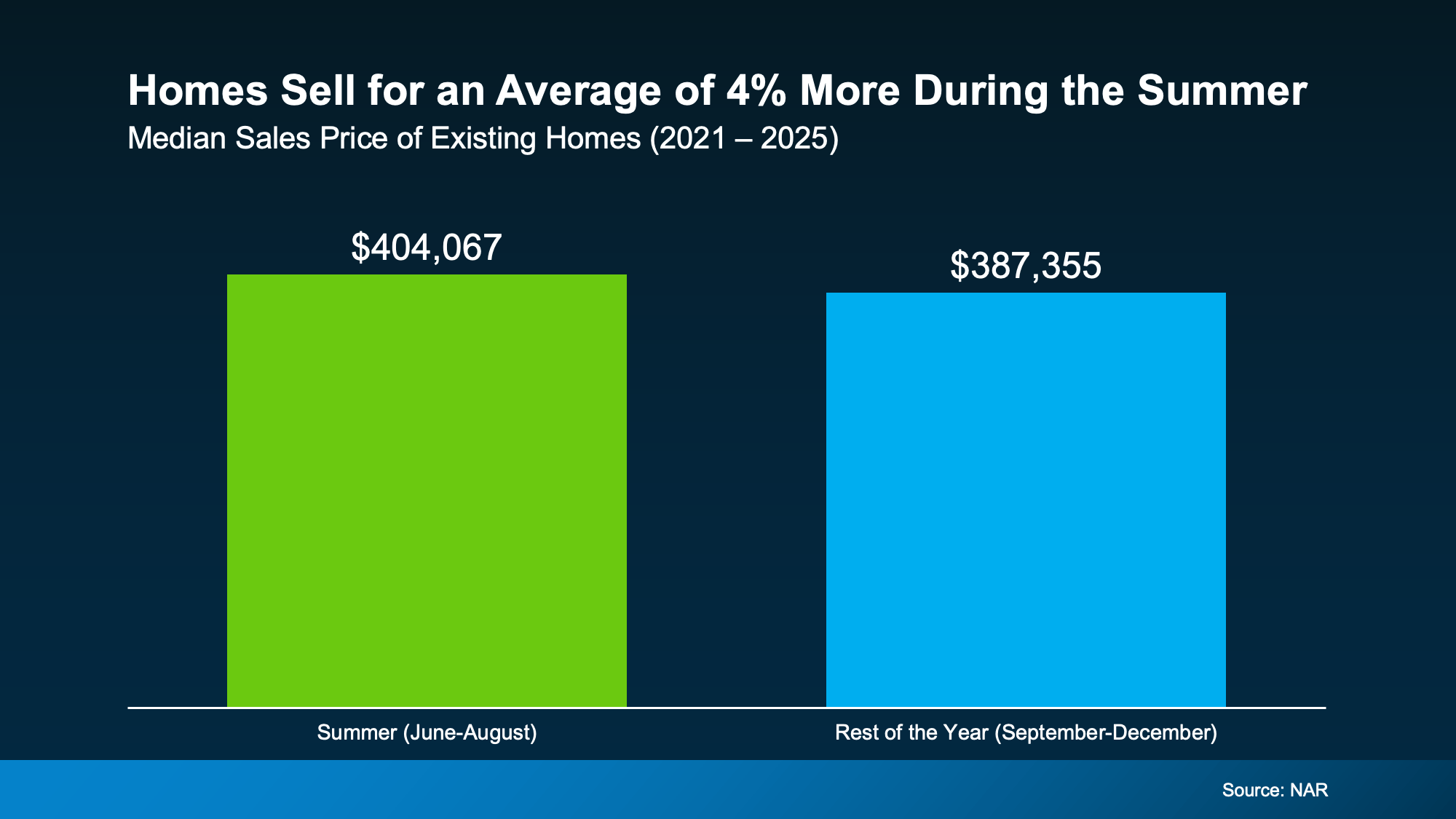
Why? Summer buyers are usually operating on a set timeframe. They’re trying to move before the next school year or when they have more PTO and warmer weather to tour houses. That urgency can translate into better offers.
Now, that doesn’t mean you should price your house 4% higher this Summer. That would actually be a mistake in today’s market.
It just means if you’re looking to get as much for your house as you reasonably can, a Summer move could be a smarter play than waiting until later this year.
Because based on typical seasonality, you may get more for your house than you would if you waited until the Fall or Winter (when there are typically fewer buyers active).
And if you’re considering a move anyway, that’s worth factoring in.
Bottom Line
Could waiting until later this year work out? Sure. But it’s important to understand what you may gain by moving now too – that way you have the full picture before you decide.
If a 2026 move is on your radar, let’s connect and talk about what matters most to you. Depending on your priorities, Summer could be your moment.
Thank you for reading
Denise Olivares-Molina

by Denise Olivares-Molina | Apr 27, 2026 | 2026 Housing Market, Advice for Sellers, Costs, Economy, For Sellers, Home Prices, Home Selling Strategy, Homeowner Information, Housing Market, Housing Market Updates, Interest Rates, Real Estate Goals, Real Estate Investing, Real Estate Market, Real Estate Trends in 2026, Seller, Sellers, Selling A Home, Selling Myths, Selling Tips, Weekly
There’s a lot of uncertainty right now and that’s leading to some dramatic headlines. And if you’re thinking about buying a home, that can make you feel a little less sure about your decision.
A recent study by CNBC asked homebuyers what they’re most worried about, and three themes kept coming up again and again:
- Mortgage rates
- The number of homes for sale
- Home prices
But a lot of what you may be hearing on those is based more on misconceptions. Not facts. So, let’s break it down and separate fact from fiction.
Misconception #1: “I’ll Just Wait, Because Mortgage Rates Are Going To Fall Dramatically”
One idea doing its rounds on social is that mortgage rates are going to drop dramatically soon. So, it’s better to wait to buy.
But is that really what’s expected?
While mortgage rates have come down a bit in the last few weeks, forecasts don’t show a major drop ahead. The most likely scenario is that rates stay somewhere in the low 6% range this year.
And that’s not a big change from where rates are now (see graph below):
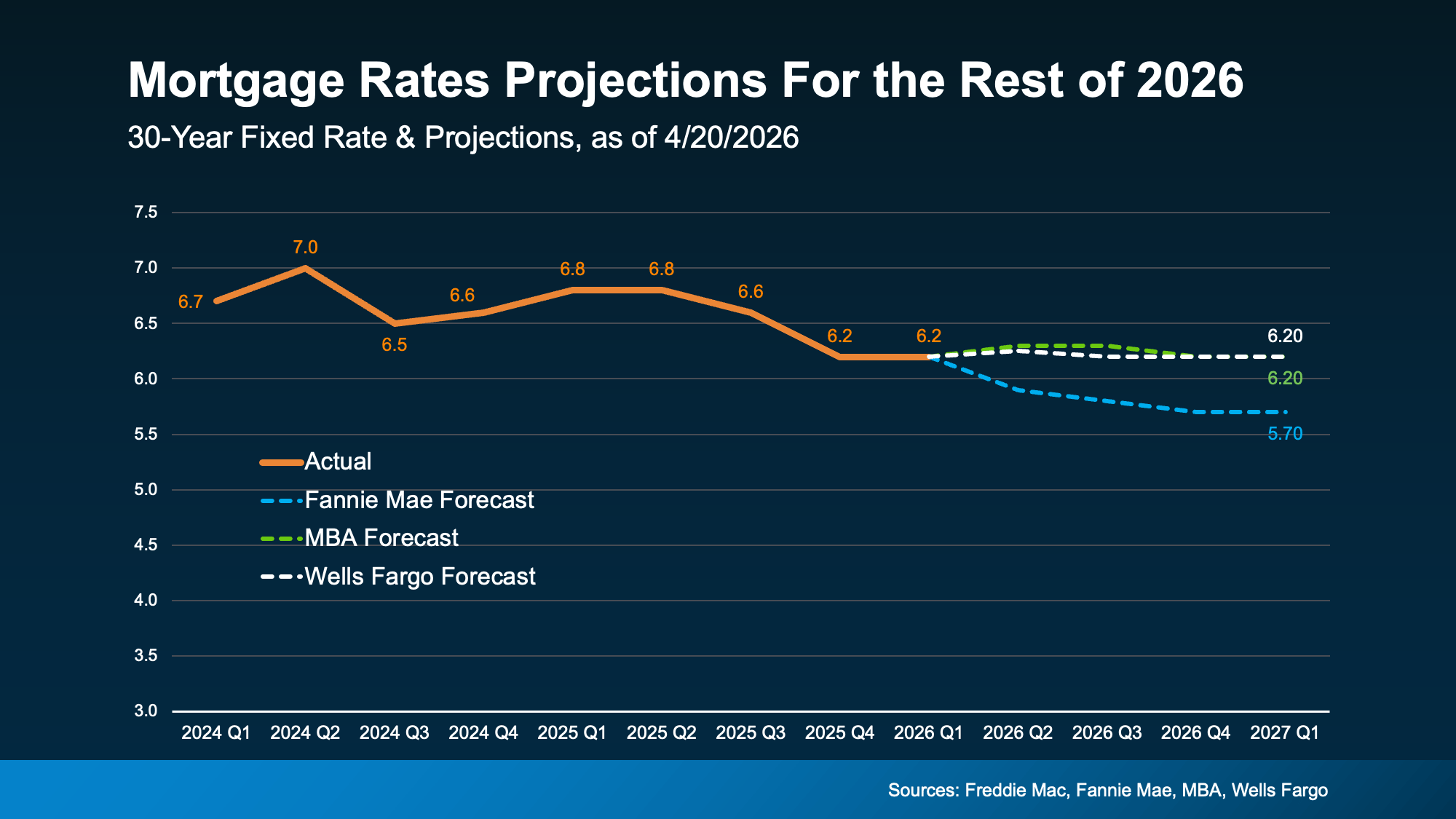 Of course, this depends on where inflation and the economy go from here. But, based on what we know today, waiting for a big drop in rates may not work out the way some people hope. As U.S. News explains:
“Mortgage rates aren’t expected to change much over the next several quarters . . .”
Not to mention, even with rates where they are today, it’s already more affordable than a year ago. So, even if they don’t change much, it’s still better than it was.
Misconception #2: “There Are Too Many Homes for Sale Right Now”
You’ve probably heard inventory is up. And nationally, it is. The number of homes for sale is 8% higher than this time last year. But that’s not a bad thing. In fact, it’s one of the reasons buyers have a bit more breathing room right now.
The problem is the headlines are making something good, sound bad. They’re focusing on how this is the most inventory we’ve had since 2019 or how many homes builders are building. And that can make it sound like the number of homes for sale is rising too far, too fast.
But that’s not what the bigger picture shows.
Data from Realtor.com proves that, even though inventory is up compared to last year, it’s still nearly 14% lower than it was during the last normal housing market (2017-2019):
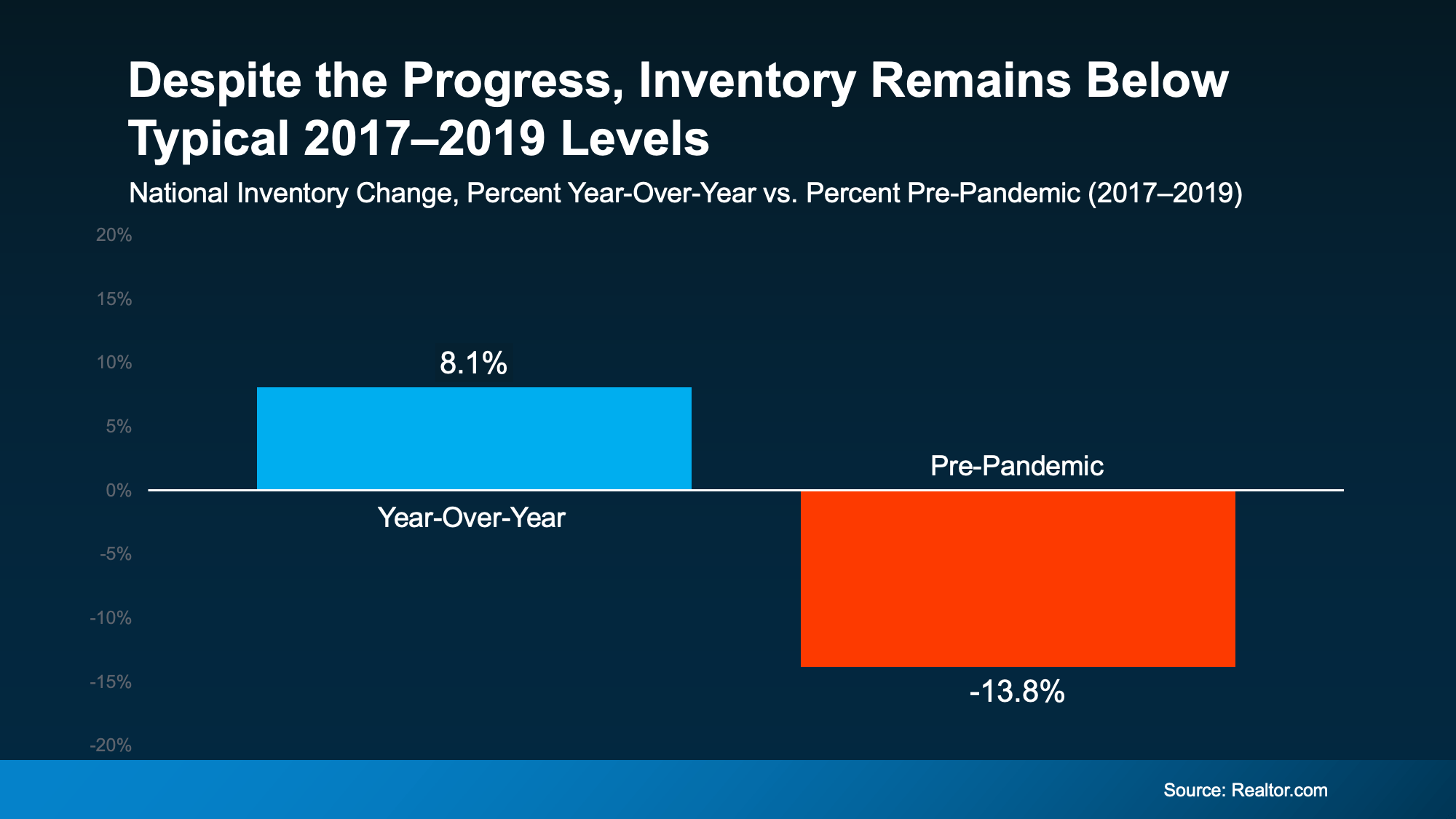 While it can vary a lot based on where you live, only 9 states have more inventory than pre-pandemic today. That’s a key reason why there still aren’t enough homes for sale to trigger something like the crash back in 2008.
Misconception #3: “Home Prices Are About To Crash”
You’ve probably seen this one, too. The confusion is coming from the fact that some metros are experiencing slight price declines. And influencers are running with that and saying prices are crashing. But that’s not the reality.
Most areas are seeing prices rise, not fall. And that’s because:
- Many homeowners aren’t selling because they don’t want to give up the low mortgage rate they locked in a few years ago. And that’s keeping a lid on how much inventory can grow.
- Since inventory is still below pre-pandemic norms, there aren’t enough homes for sale to cause a price crash.
- And even in markets with more inventory, some sellers are choosing to pull their homes off the market instead of cutting prices.
And those are 3 big reasons prices aren’t headed for a crash.
And even in the markets experiencing mild declines, the drops aren’t enough to cancel out the big gains most homeowners have seen in the last 5 years(see graph below):
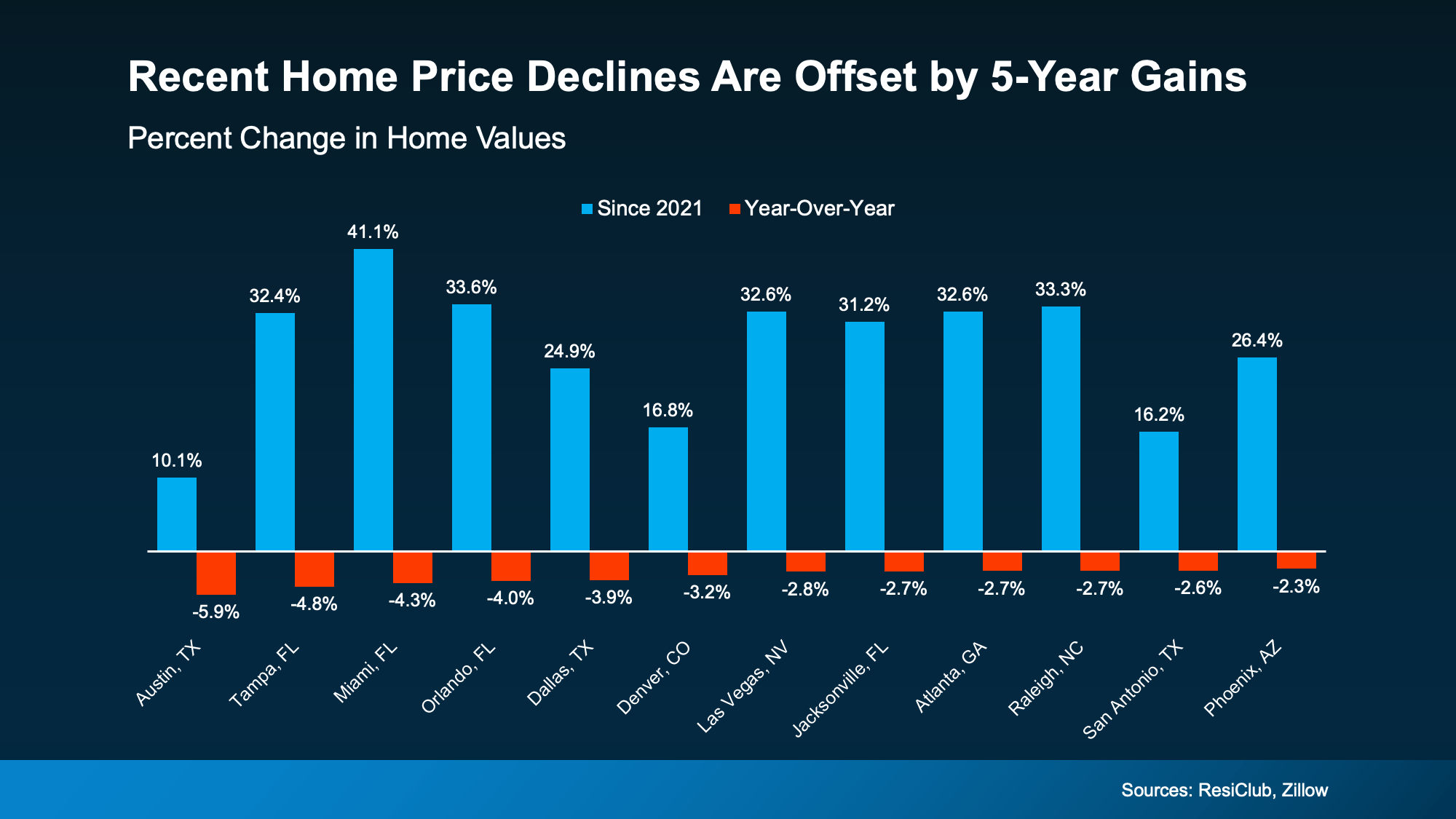 That’s not a crash. That’s just prices moderating after a few record-breaking years.
Bottom Line
Online posts are going to make things sound worse than they are. If you want a true, data-bound look at what’s really happening in today’s market, lean on a real estate agent.
Let’s connect so you have someone to separate fact from fiction today.
Thank You For Reading
Denise Olivares-Molina

by Denise Olivares-Molina | Mar 30, 2026 | 2026 Housing Market, 2026 Mortgage Rate, Advice for Buyers, Affordability, Costs, Current Trends, First Time Home Buyers, First-Time Buyers, For Buyers, Home Equity Loans, Home Prices, Home value, Housing Market Shifts, Housing Market Updates, Infographic, Interest Rates, Pricing, Real Estate Finances, Real Estate Market, Real Estate Tips, Real Estate Trends in 2026, Weekly
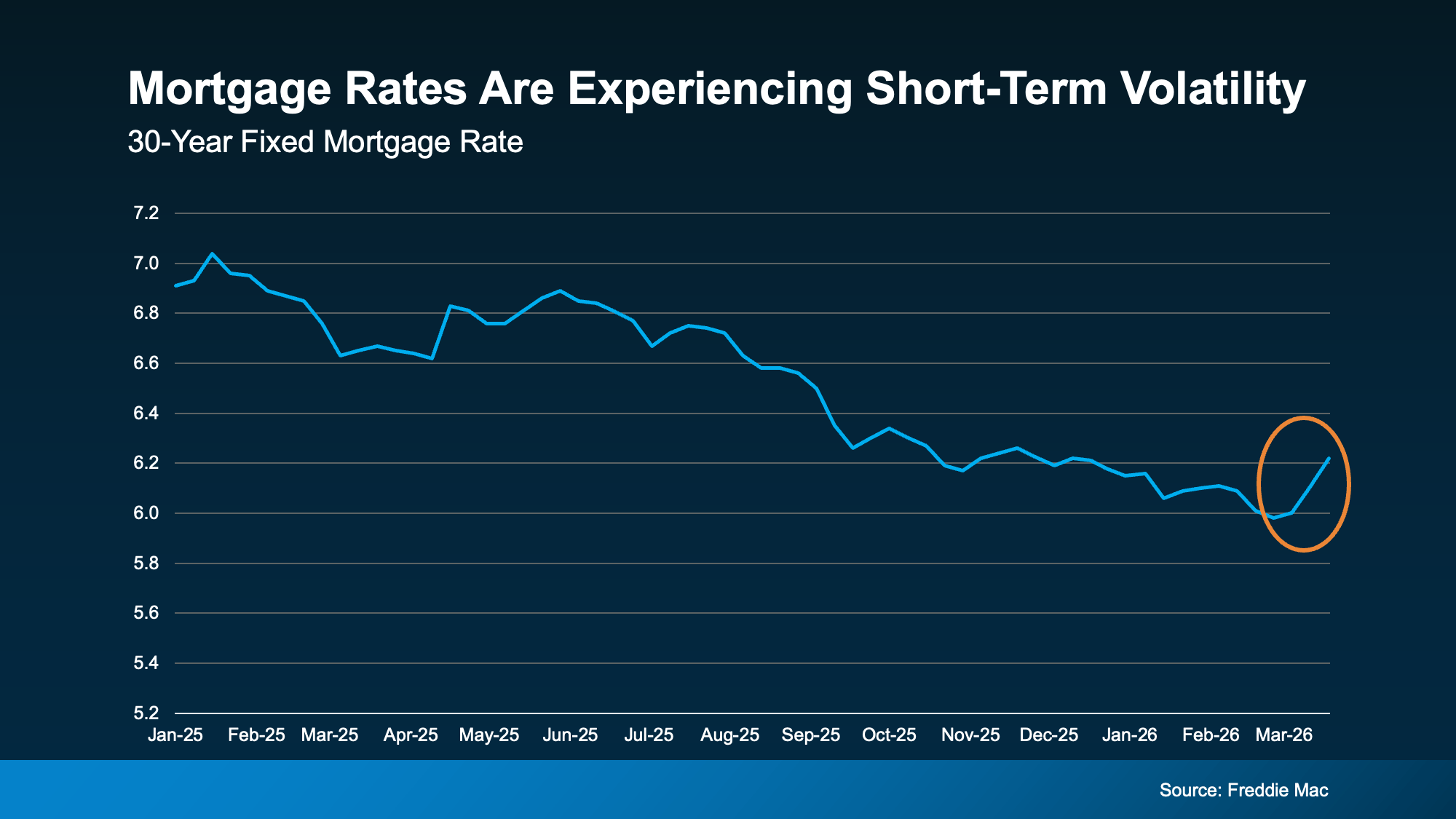
Mortgage rates have been volatile lately. And if you’re thinking about buying a home, that can make it harder to plan. But there are still things you can do to get the best rate possible in today’s market. It starts with having the right information.
So, what’s causing the bumps in rates? And what can you do about it? Let’s break it down.
Mortgage Rate Volatility Is Normal
Data from Freddie Mac shows the recent volatility. After trending down for well over a year, there was a rise this month (see graph below):
While it’s easy to be distracted by the changes, here’s what you need to remember.
It’s normal for rates to bounce around a bit here and there. For example, if you look back at the graph, you’ll see that even within the past year there have been times like this when rates inched up. We’re in one of those moments right now and you need to be aware of that.
Especially when there’s economic uncertainty or big global events happening, volatility like this is expected. As Investopedia explains:
“Mortgage rates don’t move in isolation. When global events inject uncertainty into financial markets . . . that can ripple through to borrowing . . . mortgage costs can respond quickly to geopolitical developments. As long as uncertainty remains elevated, rate swings may continue.”
And that’s one of the reasons why trying to time the market isn’t a wise move.
You can’t control what happens with mortgage rates. But there are still things you can do to help you get the best rate possible in today’s market. And here’s where to focus your effort.
Your Credit Score
Your credit score plays a big role in the rate you qualify for. Even a small improvement can make a noticeable difference in your monthly payment. As Bankrate puts it:
“Your credit score is one of the most important factors lenders consider when you apply for a mortgage. Not just to qualify for the loan itself, but for the conditions: Typically, the higher your score, the lower the interest rates and better terms you’ll qualify for.”
So, make sure you do what you can to keep your credit score up. If you’re not sure what your score is or how you can improve it, talk to a trusted loan officer.
Your Loan Type
There are also different types of home loans – and each one can have unique requirements, benefits, and rates for qualified buyers. The Consumer Financial Protection Bureau (CFPB) explains:
“There are several broad categories of mortgage loans, such as conventional, FHA, USDA, and VA loans. Lenders decide which products to offer, and loan types have different eligibility requirements. Rates can be significantly different depending on what loan type you choose.”
That’s why it’s so important to explore your options with a lender. You may even want to talk to multiple lenders to see how the options vary.
Your Loan Term
The length of your loan matters too. Most lenders typically offer 15, 20, or 30-year loans. Freddie Mac offers this advice:
“When choosing the right home loan for you, it’s important to consider the loan term, which is the length of time it will take you to repay your loan before you fully own your home. Your loan term will affect your interest rate, monthly payment, and the total amount of interest you will pay over the life of the loan.”
Again, to figure out what makes the most sense for your budget and long-term goals, have a lender walk you through all your options.
Bottom Line
Thinking about buying right now? The best advice is to accept that you can’t control where rates are going to go from here.
What you can do is work with a trusted lender and take steps that’ll help you get the best rate possible.
So, if you want to move today, let’s make it happen. We just need to control the controllables and focus where it counts.
Thank you for reading
Denise Olivares-Molina
